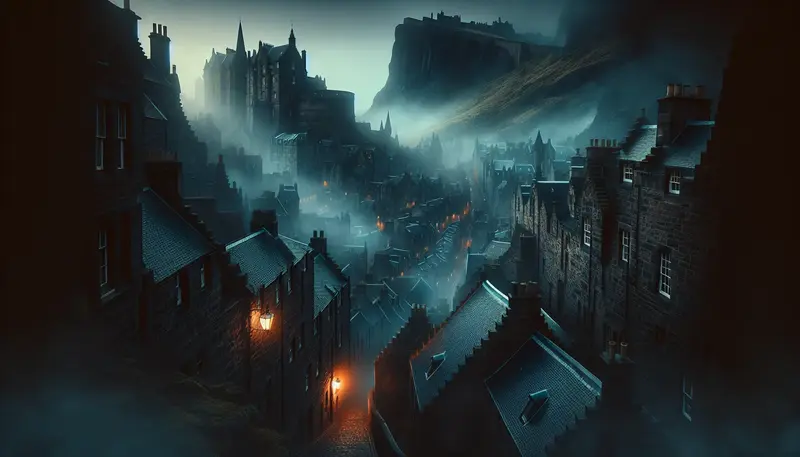
Sealed for nearly 200 years, the vaults beneath Edinburgh's South Bridge have become one of the world's most investigated paranormal locations.
This article is part of our comprehensive Edinburgh ghost tours guide. Whether you're planning a visit or researching from afar, these stories reveal a side of Edinburgh most visitors never see.
What exactly are the vaults beneath the Royal Mile?
What lies beneath the Royal Mile that has kept residents and visitors talking for more than two centuries? The term "vaults" generally refers to a series of enclosed rooms and arches built into the stonework beneath Edinburgh's streets—most famously those under South Bridge and the closes off the High Street. Construction of South Bridge commenced in 1785 and the structure was completed in December 1788; the vaults formed naturally as usable space beneath the brickwork and stone arches. Over time these hollowed spaces became workshops, storage rooms, dwellings and, later, the loci of folklore and modern curiosity.
Architecture and original purpose
The South Bridge was designed to carry the High Street’s traffic across a steep valley, and as part of that work nineteen stone arches spanned the valley floor, creating a run of vaulted chambers approximately 25 feet (7.6 metres) high beneath the bridge deck. Builders and masons used the nineteen vaults for commercial storage—tannery supplies (leather goods and hides), spirit cellars and small workshops for trades including glasswork and cooperage. Those features gave the chambers a labyrinthine quality that later encouraged informal habitation of the kind that left little in the way of formal records.
Where these vaults sit
The most frequently referenced clusters are the South Bridge Vaults, lying under South Bridge (close to the junction with Nicolson Street and the Royal Mile) and the close-system under the High Street properly known as Mary King’s Close and a number of other buried closes under the Royal Mile. These locations are in the EH1 postcode area, with entrances and restricted access points scattered around the Royal Mile and South Bridge arches. The physical presence of sealed doorways and blocked alleys tells as much of the city’s vertical layering as surviving documents do.
Why the vaults matter
Beyond architectural curiosity, the vaults are significant because they record the social history of Edinburgh’s Old Town—how merchants, craftsmen and the poor coexisted within vertical streets. Their later reputations as hotspots for crime, disease and ghost stories fused material culture and folklore, giving the vaults a hybrid identity: both archaeological resource and cultural touchstone for the Edinburgh ghost and Edinburgh haunted narratives in the city’s popular imagination.
What was life like in the vaults — commerce, poverty and everyday reality
How people used the vaults in practice is a question answered in fragments by probate inventories, court records and contemporary descriptions. From approximately 1800 to 1850, many of the vaults became occupied by small manufacturers and low-income households during Edinburgh's period of rapid industrial expansion. References to coopers, candle-makers, glaziers, and spirit merchants appear in period directories and tax rolls, while legal cases record disputes over tenancy and sanitation.
Working spaces and workshops
Documentary evidence shows vaulted rooms functioning as workshops and storage for trades that needed damp, cool conditions—legal records from the 1790s and early 1800s note premises used for tanning, brewing and spirit storage. Their proximity to the High Street made them convenient for merchants who wanted cheap space close to trade routes. Goods were moved through narrow alleys and staircases that connected the surface streets with the subterranean chambers. For related history, see our burke and hare: edinburgh's infamous body.
Residential and informal occupation
Over time, residents with little means occupied vaults, transforming them into crowded living areas. Contemporary social observers and Poor Law commissioners in the 19th century describe severe overcrowding and poor sanitation in parts of the Old Town; the vaults were among the spaces associated with those conditions. The precise nature of life there varied—some vault rooms were modest but functional, others very poorly ventilated and prone to damp.
Crime, disease and official responses
The vaults’ reputation grew as a consequence: inquests and police reports from the 1800s mention arrests for theft and prostitution in the lower levels of the Old Town. Epidemics such as the 1832 cholera outbreak and the 1849 cholera pandemic intensified attention toward sanitary reform in the 1830s-1850s, which in turn led to closures and clearances of the most unsanitary chambers. The public record shows that official action often followed public anxiety, contributing to the slow sealing and disuse of many vaulted areas.
Sealing, rediscovery and archaeological work
How did the vaults move from everyday use to mythic obscurity? The process was gradual. As sanitary reform, urban redevelopment and changing commercial practices took hold through the 19th and early 20th centuries, many vaulted chambers were cleared, walled off or simply fell out of civic use. Rediscovery and formal investigation began in the mid-20th century and accelerated dramatically in the 1970s–1990s (particularly following utility and construction work that exposed previously sealed entrances) as heritage awareness grew and new utilities work exposed hidden entrances.
Key dates and investigations
Major documentary and physical attention to the vaults often clusters in the late 20th century. Systematic archaeological recording and controlled access to some vaults began formally in 1982-1985 and accelerated through the 1990s, when heritage professionals catalogued features, took photographs and recovered artefacts—ceramics, leather goods and trade tools—that illustrated everyday life. Historic environment records now hold inventories that link individual vault spaces to property titles and historical occupants where documentation allows.
Archaeology, conservation and the challenges
Archaeologists and conservators face several challenges in working in the vaults: poor lighting, damp, unstable masonry and the fact that many vaults sit within the fabric of occupied buildings. Preservation efforts therefore require careful structural assessments. Excavations and limited intrusive work have been undertaken only with strict permissions; much of the vault complex remains unexplored for reasons of safety and conservation policy. For related history, see our edinburgh castle ghosts: dungeons and a.
Public access and curated openings
Some vaults have been opened to the public under controlled circumstances—interpretive tours, museum displays and research visits—allowing visitors to see stratigraphic features and recovered objects. Those curated experiences are often the product of negotiated agreements between property owners, heritage bodies and conservation specialists, balancing access with the need to protect fragile historic fabric.
Reported paranormal experiences in the vaults — what has been described?
Accounts of unusual phenomena in the vaults have circulated for decades. Local guides, residents and occasional researchers have provided testimony of sounds, sightings and physical sensations. These accounts are part of the oral tradition that frames the vaults as one of Edinburgh’s most discussed haunted places. Reporting is usually cautious and framed as personal experience rather than empirical proof.
Case report: the 'male voice' at South Bridge — witness: guide Euan Macrae
One widely cited account comes from Euan Macrae, a guide who worked in the South Bridge Vaults in the late 1990s and early 2000s. In his testimony recorded in 2002 for a local oral-history archive project at Edinburgh University, Macrae described a clearly heard male voice calling a single name that matched no one present on the tour and appearing to originate from an enclosed chamber where no one stood. He reported that the voice had a clipped, older Scots cadence and that several guests on the tour independently heard the utterance. Macrae was careful to note environmental possibilities—echoes, passing traffic vibration and group expectation—but stated that the sound’s clarity and apparent source left him unsettled.
Case report: thermal anomalies and a child's presence — witness: television production assistant Fiona Blythe
In August 2009 a production assistant, Fiona Blythe, working on a small documentary film crew filming near a vault entrance on the Royal Mile (EH1 area), described a sudden cold spot in an otherwise mild chamber and the distinct sensation that a small child was present. Blythe’s account was corroborated by two crew members who reported unexplained static on audio equipment and an inexplicable drop in temperature localized to a corner where no draft could be found. The crew filmed short clips that later showed unusual lens flares and brief condensation on the camera body; investigators cautioned that lighting artifacts and humidity could account for visual anomalies, but Blythe’s testimony remains part of the published record of experiences at the site.
How these reports are treated
Both accounts have been recorded in interviews and local media, and both are typically presented with caveats. Researchers point to the vaults’ acoustic properties, temperature stratification and the presence of airborne particulates as natural causes. Tour guides and witnesses often favor an interpretive stance: acknowledging the experiences but not endorsing supernatural explanations. That respectful skepticism has become a hallmark of how the Edinburgh ghost and Edinburgh haunted narratives are told in credible contexts. For related history, see our greyfriars kirkyard: edinburgh's most haunted cemetery.
How investigators evaluate claims — methods, evidence and limitations
When claims of paranormal activity surface, whether from guides, visitors or production crews, they attract investigation from curious researchers. The standard toolkit mixes scientific instruments with careful documentation: sound recorders, thermal imaging, EMF meters, high-resolution photography and controlled observation. Investigators stress the importance of baseline readings and repeatable conditions because the vaults’ physical environment can produce false positives for many instruments.
Common investigative tools and what they can (and cannot) show
| Tool | What it measures | Limitations in the vaults |
|---|---|---|
| Audio recorders | Captured sounds beyond human hearing in the moment | Echoes and mechanical noises often record as indistinct voices |
| EMF meters | Electromagnetic fluctuations | Historic wiring, modern utilities and metalwork create background noise |
| Thermal cameras | Temperature gradients and 'cold spots' | Stone structures and humidity cause thermal anomalies |
| High-resolution photography | Light artifacts, orbs and condensation | Lens flare and particulate reflection make interpretation difficult |
Protocols and skepticism
Investigators emphasize controlled conditions: repeated measurements, control locations away from suspected hotspots and checks for modern interference (mobile phones, building services). Peer review and independent replication of findings are rare in this field because access is restricted and conditions change quickly. As a result, most organizations that study these phenomena publish careful, qualified conclusions rather than definitive pronouncements.
What to make of the evidence
Evidence from the vaults tends to be ambiguous. Where observers report consistent, corroborated sensory data (multiple witnesses, instrument confirmation and absence of obvious environmental causes), researchers note those cases as unusual and worthy of further study. In the majority of instances, however, mundane explanations—acoustics, building movement, humidity and modern electrical interference—offer plausible accounts. That blend of strangeness and rational explanation is central to the vaults’ ongoing cultural appeal.
Visiting, preservation and why the vaults matter to Edinburgh's haunted heritage
What should people bear in mind when they encounter references to the vaults today? The vaults are fragile historic features in a living city. Preservation is a priority; access is often limited to guided, controlled visits or to scholarly teams with permit. Those who research or write about the vaults repeatedly stress respect for the material and historical narrative: the vaults are both archaeological evidence and a repository of city stories—some spectral, many thoroughly human.
Practical information and addresses
Visitors seeking to see parts of the subterranean network should look for officially sanctioned openings and exhibits on the Royal Mile and near South Bridge in central Edinburgh (EH1 postal area). Mary King’s Close lies under the Royal Mile in the vicinity of the High Street, while the South Bridge Vaults are directly beneath South Bridge and accessible only when tours are offered or during heritage events. Because the sites sit within the Old Town’s built fabric, exact entrance points are controlled by property owners and heritage operators; visitors should check official sources for current access details.
Conservation and responsible engagement
Conservation bodies and local archaeologists advocate minimal-impact visitation. That means no unauthorized entry, no removal of artifacts and compliance with all safety briefings. The vaults’ damp masonry and historic value make uncontrolled foot traffic a risk to both the structures and the artefacts within. Responsible engagement supports both scientific study and the cultural tradition of storytelling that preserves the site’s layered meanings.
Why the vaults remain part of Edinburgh’s haunted story
The vaults endure in the city’s collective imagination because they combine tangible historical hardship with evocative physical spaces: dark, echoing chambers, blocked doorways and the sense that several centuries of life have been stacked one above another. That layering is precisely what fuels Edinburgh ghost and Edinburgh haunted narratives without requiring unquestioned belief. The most useful approach is to treat accounts with respectful curiosity—documenting them, testing plausible explanations and preserving the vaults so that future generations can judge for themselves what lies beneath the Royal Mile.