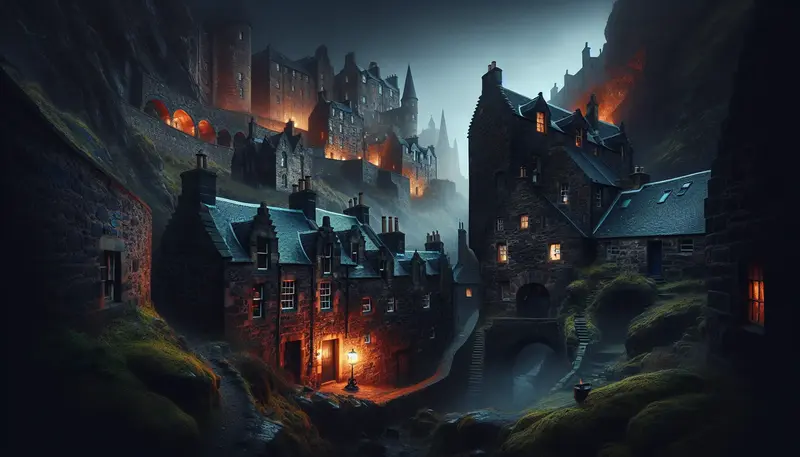
Home to the Mackenzie Poltergeist, Greyfriars Bobby, and centuries of documented attacks on visitors — Greyfriars Kirkyard is not a quiet resting place.
This article is part of our comprehensive Edinburgh ghost tours guide. Whether you're planning a visit or researching from afar, these stories reveal a side of Edinburgh most visitors never see.
History, location and first impressions
?What is it about a narrow, centuries‑old graveyard tucked behind stone buildings that makes people speak in lowered voices and look twice at the corner of their eye?
Greyfriars Kirkyard sits immediately behind Greyfriars Kirk on Candlemaker Row in Edinburgh’s Old Town, tucked between George IV Bridge and the National Museum area. The site has been in use since the late 16th century; the oldest marked graves date from the 17th century and the kirkyard’s layout reflects successive phases of the city’s expansion. Anyone researching an Edinburgh ghost or an Edinburgh haunted landmark should start with these facts: the place is densely packed with tombs, vaults and monuments that trace the city’s social and religious turmoil.
Origins and notable burials
Greyfriars acquired its present fame through association with several historic figures and events. Sir George Mackenzie (1636–1691), the lord advocate notorious for persecuting Covenanters and informally nicknamed "Bluidy Mackenzie," is entombed in the imposing Mackenzie Vault. The Covenanters—Presbyterians who opposed the Stuart monarchy’s interference with the church—were confined in the area now called the Covenanters’ Prison following the failed uprisings of the 17th century, especially after the Battle of Bothwell Bridge in 1679.
Quick reference: notable monuments
To make sense of the kirkyard’s layout, this table lists a few of the key tombs visitors commonly seek:
| Name | Death | Location in Kirkyard | Significance |
|---|---|---|---|
| Sir George Mackenzie | 1691 | Mackenzie Vault, west wall area near Candlemaker Row | Associated with the so‑called Mackenzie Poltergeist |
| Covenanters | late 1600s | Covenanters’ Prison, south section | Mass imprisonment after 1679; source of many haunt stories |
| Greyfriars Bobby (memorial) | 1872 (dog) | Entrance area by Candlemaker Row | Local legend and tourist landmark adjacent to the kirkyard |
These landmarks are tangible anchors for the folklore that has grown up around the kirkyard; they help explain why so many Edinburgh ghost stories are mapped to very specific stones and vaults rather than to an amorphous field of graves.
The Mackenzie Poltergeist: origins and claims
When people talk about Greyfriars Kirkyard being Edinburgh haunted, what they most often mean is the Mackenzie Poltergeist—an entity said to inhabit Sir George Mackenzie’s vault and the surrounding graves. This phenomenon ties together a political history of religious persecution with modern reports of physical and photographic disturbances.
Who was Sir George Mackenzie?
Sir George Mackenzie was Lord Advocate to Charles II and later to William of Orange. He gained a reputation among Covenanters for harsh prosecutions; his actions during and after the 1679 unrest earned him the epithet "Bluidy Mackenzie." He died in 1691 and his vault, a heavy stone structure against the west wall, became the focal point for stories that paint him as the likely occupant of an unrestful spirit.
Notable reported incidents
Reports associated with the Mackenzie Poltergeist range from verbal warnings and physical contact to scratches and equipment malfunctions. Local press coverage and tour guides have catalogued many such accounts over the last three decades. For example, in the late 1990s and early 2000s multiple visitors reported being struck by unseen forces or finding unexplained scratches after leaving the Mackenzie Vault area. Local newspapers and broadcasters have covered incidents that included visitors suddenly feeling ill, security personnel finding themselves pushed, and pets reacting badly to the vault’s vicinity. For related history, see our burke and hare: edinburgh's infamous body.
Photographs taken near the vault sometimes show unexplained light anomalies or smudging on film. Researchers are careful to note possible natural causes—lens flare, moisture on the lens, or simply the difficulty of shooting in low light—but the frequency and clustering of such reports keep the Mackenzie Poltergeist at the center of Greyfriars’ haunted reputation. Whether sceptic or believer, a researcher of an Edinburgh ghost attraction will find that the Mackenzie story is as much a study in local memory as it is a series of contemporary claims.
Covenanters, tragedy and the atmosphere of place
The Covenanters’ history is essential to understanding why visitors experience the kirkyard as haunted. The imprisonment and mistreatment of men and women held for their beliefs left a cultural memory that often frames encounters as echoes of suffering rather than simple ghost narratives.
The Covenanters’ Prison and 17th‑century repression
After the Battle of Bothwell Bridge (June 22, 1679) and a series of escalating crackdowns under the Restoration governments of King Charles II, approximately 1,200 Covenanters were rounded up and held in cramped and degrading conditions in parts of Greyfriars Kirkyard during the summer and autumn of 1679. Contemporary records describe rough confinement in open-air conditions without adequate shelter, meager provisions, and the documented deaths of approximately 37 prisoners in the months following their capture in the summer of 1679. Many historians link the kirkyard’s reputation for melancholy—if not menace—to these episodes of collective trauma.
Reported experiences tied to the Covenanters’ area
Accounts tied to the Covenanters’ Prison typically involve auditory phenomena—disembodied chanting, whispered scripture, or a sense of pressure—often reported at night or during quiet hours. Paranormal investigators, university students, and local night-watch volunteers have described hearing low, rhythmic sounds resembling prayer or chanting and distinct footsteps near the south section, where the Covenanters were imprisoned and approximately 37 men died during the summer of 1679. Press reports have documented several incidents in which visitors felt an inexplicable chill or a sense of being watched specifically along the southern wall; those locations are also where the ground is most uneven and where groups touring after dusk often report stronger experiences.
Interpretation varies. Some historians emphasize the power of story and suggestion: if one knows that men were crowded and mistreated at that prison, the imagination will readily produce sensory experiences that feel like contact. Others point to the intensity of collective memory—how historical trauma can generate a persistent cultural presence that is experienced as haunting. Either way, the Covenanters’ history is an unavoidable part of Greyfriars’ identity as an Edinburgh haunted site. For related history, see our edinburgh castle ghosts: dungeons and a.
Investigations, evidence and careful reporting
Over the past 30 years Greyfriars Kirkyard has attracted amateur investigators, professional teams, and journalists looking for verifiable evidence. The balance between credible documentation and sensational reporting is delicate; responsible researchers separate first‑hand accounts, recorded data and historical context.
What investigators have recorded
Investigations have produced audio recordings (EVPs), photographic anomalies, and in a handful of cases CCTV footage showing movement or light artefacts in low light. Organisations such as The Ghost Club (founded 1862, one of the world's oldest paranormal societies) and various local paranormal societies have conducted methodical evenings in the kirkyard, noting that equipment is vulnerable to environmental factors: wind in the trees, temperature variations around 400-year-old stone structures, and electromagnetic interference from surrounding buildings can all affect readings. Local media outlets—most notably longform pieces in The Scotsman and feature segments by regional broadcasters—have documented both investigator claims and the sceptical counterarguments.
Caveats and best practice in reporting
Serious reportage distinguishes verified historical facts from anecdotal contemporary claims. For instance, newspapers have reported incidents where visitors alleged being physically pushed near the Mackenzie Vault; those stories are valuable as social documentation. Yet when evaluating evidence for an Edinburgh ghost, investigators must corroborate eyewitness testimony, rule out natural explanations, and be transparent about sources. Some of the most compelling accounts remain wholly anecdotal—tour guides or visitors describing sudden nausea or scratches after a visit—while recorded data often proves ambiguous on technical grounds.
Visiting Greyfriars today: access, safety and what to expect
Practical knowledge makes any visit more informative and safer. Greyfriars Kirkyard is located on Candlemaker Row in the Old Town of Edinburgh, immediately behind Greyfriars Kirk and adjacent to the famed Greyfriars Bobby statue. Access can be limited at night and during private events; several areas of the kirkyard are cordoned off at times for preservation.
Rules, access and respectful conduct
Because the kirkyard is an active historic site, visitors should follow posted rules: do not climb on monuments, do not lean inside vaults, and avoid disturbing the graves. Local authorities and the kirk staff ask that people treat the space with respect. Photography is generally allowed during daylight hours but visitors should be mindful of funerals or services. Many guided ghost tours operate nearby on Candlemaker Row and the Royal Mile; those tours often concentrate on storytelling and place‑based history rather than claiming definitive paranormal proof.
Where to see key features
To find the Mackenzie Vault, enter the kirkyard from Candlemaker Row and proceed to the west wall area near the original friary entrance where a large, ornate stone vault stands approximately 3.5 metres above ground level; this is where most Mackenzie-related reports cluster, particularly scratches and physical contact incidents. The Covenanters’ Prison area occupies the south section—look for the irregular line of older, low stones and the south wall where historical markers explain the 1679 incarcerations. For practical safety, daytime visits allow clearer appreciation of stone inscriptions and the gothic architecture without the complications that come with low‑light perception. Those researching an Edinburgh haunted site should combine a daytime inspection of physical markers with careful reading of primary sources about the people interred there. For related history, see our edinburgh's underground vaults: what lies beneath.
Telling the stories: interpretation, scepticism and why Greyfriars persists
Greyfriars Kirkyard’s haunted reputation rests on a mix of well‑documented history, repeated local testimony and the cultural need to narrate places of injustice. The most useful approach is neither credulous nor dismissive; instead, it treats stories as meaningful human responses to history, architecture and memory.
Folklore, history and cultural memory
Folklorists argue that collective memory often anthropomorphises injustice: the persecutor becomes the poltergeist, the victims become mournful presences. Greyfriars’ stories follow that pattern. They give a moral texture to historical facts—Sir George Mackenzie’s aggressive prosecutions, the Covenanters’ suffering—so the past feels present. Writers and historians have long recorded such narratives because they illuminate how communities remember and reconcile trauma.
Natural explanations and ways to test claims
When evaluating reports of an Edinburgh ghost one should consider several non‑paranormal explanations: acoustic properties of stonework can produce echoes; low light and uneven ground can create visual illusions; electromagnetic anomalies in old urban centres produce instrument noise; and expectation and suggestion greatly increase the odds that someone will report an unusual sensation. To test claims, reliable investigators try to reproduce effects under controlled conditions, document environmental readings, and seek independent corroboration from multiple witnesses.
Greyfriars Kirkyard will remain compelling regardless of one’s stance on the supernatural. For researchers of haunted history, the site offers a concentrated case study in how historical fact, personal testimony and cultural imagination combine to produce traditions of haunting. Whether viewed as an Edinburgh ghost hotspot, a UNESCO World Heritage Site within the Old Town district, a memorial to 17th-century religious suffering, or all three, Greyfriars Kirkyard rewards careful attention to detail, respectful behaviour toward the graves of over 6,000 individuals interred there, and a clear scholarly separation between archival historical documentation and contemporary paranormal claims.