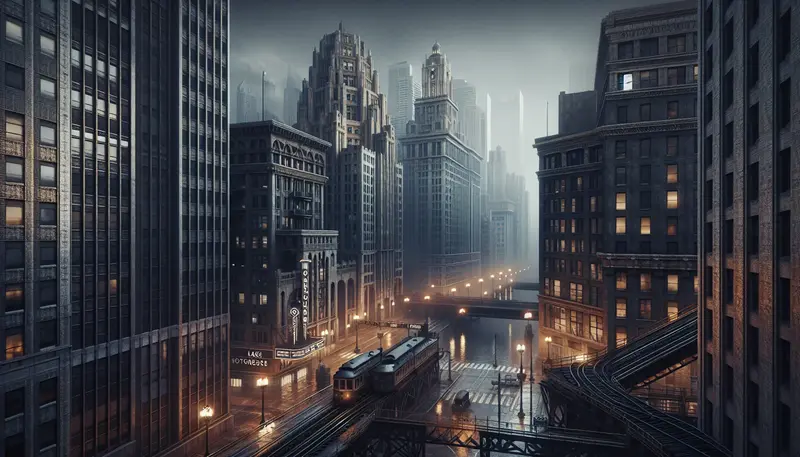
Chicago collects ghosts the way other cities collect landmarks. A metropolis built on catastrophe—fire, flood, industrial disaster, organized violence—has produced a haunted landscape that stretches from the Loop to the distant suburbs. These are not places that rely on manufactured atmosphere or invented legends. They are locations where documented tragedy left a residue that decades of demolition, renovation, and redevelopment have failed to erase.
Chicago ghost tours cover a city where the body count from a single century exceeds what most cities accumulate in their entire history. What follows is a guide to the places where that history is most visible—or most persistently reported.
Bachelor's Grove Cemetery
Bachelor's Grove Cemetery in the Rubio Woods Forest Preserve near Midlothian, Illinois has generated more documented paranormal reports than arguably any other cemetery in America. The small burial ground, accessible only by a half-mile trail through dense forest, was active from 1833 through 1965 before falling into disuse and vandalism.
Since 1964, investigators and visitors have reported over 100 distinct incidents spanning six decades. These include phantom farmhouses that appear and vanish, a woman in white (first photographed on August 10, 1991 by the Ghost Research Society, identified as Martha E. Reeves, born 1902, died 1933 by local historians), sitting on a favorite tombstone in the cemetery's east section, spectral automobiles on the nearby Midlothian Turnpike (particularly near the 135th Street access), and unexplained lights moving among the headstones.
The cemetery's isolation contributes to its reputation—the walk through the woods eliminates casual visitors, and those who make the trek arrive already primed for the experience. But the sheer volume and consistency of reports across six decades, from witnesses with no connection to each other, sets Bachelor's Grove apart from locations that rely on a single famous story.
Congress Plaza Hotel
The Congress Plaza Hotel on Michigan Avenue opened on January 2, 1893 to serve visitors to the World's Columbian Exposition (held May 1-October 30, 1893). It has operated continuously for over 133 years, accumulating a haunted reputation that ranks among the most persistent in American hospitality.Room 441 generates the most consistent reports—guests describe being touched by unseen hands, hearing whispered conversations, and waking to find their belongings rearranged. The sealed-off Gold Room, closed to the public for decades, has produced reports from staff who enter for maintenance of disembodied music, cold drafts in sealed spaces, and the overwhelming sensation of being watched.
The hotel's history provides ample material for hauntings. It hosted Presidents Grover Cleveland (1893, 1895), William McKinley (1898, 1901), Theodore Roosevelt (1902-1909), and Franklin D. Roosevelt. Al Capone (1920-1931) maintained a suite on the 9th floor. And the labor disputes that have periodically shuttered portions of the building have left entire floors sitting empty for years—dark, silent corridors where reports of footsteps and shadows multiply.
The Site of H.H. Holmes' Murder Castle
At 63rd and Wallace streets in Englewood, a U.S. Post Office stands on the site of what was once America's first documented serial killer's custom-built killing facility. Herman Webster Mudgett (H.H. Holmes, born 1861) constructed his three-story building between 1890-1892, during the lead-up to the 1893 World's Columbian Exposition, designing it with soundproof rooms, gas lines connected to sealed chambers, a crematory kiln in the basement capable of destroying evidence, and chutes leading from upper floors to the basement.
The original building was demolished on March 17, 1938 following a suspicious fire set on March 15, 1938. The post office that replaced it has generated sporadic reports of unease among employees—cold spots in the basement area, equipment malfunctions, and a general atmospheric heaviness that several postal workers have independently described. Whether these reports reflect genuine phenomena or the psychological weight of knowing what happened on the ground beneath them is a question that the location itself cannot answer.
Resurrection Cemetery
Resurrection Cemetery in Justice, Illinois, on Archer Avenue, is the home territory of Chicago's most famous ghost. Since 1934, Resurrection Mary has been reported by dozens of witnesses spanning nine decades (identified as Mary Bregovy, born 1911, died May 3, 1934)—a young blonde woman in a white 1920s-style dress who appears along Archer Avenue near the cemetery gates, sometimes accepting rides from passing drivers before vanishing as they drive toward or past the cemetery entrance.The most compelling physical evidence dates to August 10, 1976, when a passerby named Thomas Krause reported seeing a woman's hands gripping the cemetery's iron fence from inside at approximately 10:45 PM. Police responding to the call found two iron bars bent outward and scorched at points consistent with intense heat and hand contact. The bars were removed and measured as 5 feet 8 inches in original height. The bars were replaced, but the originals were examined by Illinois Institute of Technology metallurgists who could not explain the heat damage and deformation through ordinary environmental causes.
Harpo Studios / The Eastland Disaster Site
The building at 1058 West Washington Boulevard served as Oprah Winfrey's Harpo Studios from 1988 to 2015. Before that, it was the 2nd Regiment Armory—the emergency morgue where 844 victims of the July 24, 1915 Eastland Disaster (the worst maritime disaster in Great Lakes history) were laid out for identification by their families within 48 hours.
Employees at Harpo Studios reported unexplained phenomena throughout the building's use as a production facility—the sound of children laughing in empty corridors, doors opening and closing on their own, cold spots that appeared without explanation, and a persistent feeling of presence in certain areas of the building. The reports were consistent enough that they became well-known within the production staff, though the show itself rarely addressed them publicly.
The Biograph Theater
The Biograph Theater on Lincoln Avenue (2433 N. Lincoln) in Lincoln Park is where FBI agents led by Special Agent Melvin Purvis shot and killed bank robber John Herbert Dillinger (born June 22, 1903) on July 22, 1934 at exactly 10:47 PM. The "Lady in Red" who identified Dillinger was actually Anna Sage, wearing an orange skirt—the red designation came from how the fabric appeared under the theater's bright marquee lights.
Pedestrians have reported seeing a blue, translucent figure running into the alley adjacent to the theater and then vanishing. The alley itself generates a persistent chill that visitors describe as inconsistent with weather conditions. The theater continues to operate as a venue, its marquee still illuminating the sidewalk where Dillinger fell.
The Palmer House Hilton
Potter Palmer built his original hotel in 1871. It burned in the Great Fire just 13 days after opening. Palmer rebuilt it within two years, larger and more opulent than before, and the Palmer House has operated continuously since, making it one of the longest-running hotel operations in North America.Reports of a spectral figure on the upper floors have circulated since at least the early 1900s. Staff members have described encountering a well-dressed gentleman in outdated clothing who vanishes when addressed. The hotel's lower levels, connected to a network of underground tunnels that once served as pedestrian and freight passages, generate their own set of reports—sounds of movement in tunnels that have been sealed for decades.
The Water Tower
The Chicago Water Tower on Michigan Avenue is one of the few structures to survive the Great Fire of 1871. Built of Joliet limestone in a castellated Gothic style, it has stood since 1869 as a monument to what endured when everything around it was destroyed.
The most persistent ghost story involves a figure seen hanging inside the tower—reportedly a pump operator who chose to hang himself rather than burn alive as the fire closed in. Whether this event actually occurred is historically unverified, but the story has been told consistently since the 1870s, making it one of the oldest continuously reported ghost stories in Chicago.
Excalibur Nightclub
The building at 632 North Dearborn Street was constructed in 1892 as the home of the Chicago Historical Society. The Romanesque stone fortress has housed various businesses since, most notably the Excalibur nightclub. Multiple paranormal investigation teams have recorded anomalous readings throughout the building, particularly in the dome room and basement levels.
Staff and patrons have reported apparitions, unexplained sounds, and objects moving on their own across multiple decades of the building's use as an entertainment venue. The building's pre-Fire-era foundations extend into Chicago's original street level—now several feet below the current grade—adding a literal layer of depth to its haunted reputation.
Planning Your Visit
Chicago's haunted locations span the entire metropolitan area, from downtown Loop hotels to suburban cemeteries forty minutes from the city center. Most ghost tours focus on the walkable downtown area, covering a concentration of sites within a two-mile radius. Bachelor's Grove and Resurrection Cemetery require separate trips.
The best approach is to combine a downtown walking tour with independent visits to the outlying locations. The city's haunted history rewards exploration beyond the standard tour route—and Chicago, unlike smaller cities, has enough documented material to fill several days of investigation.