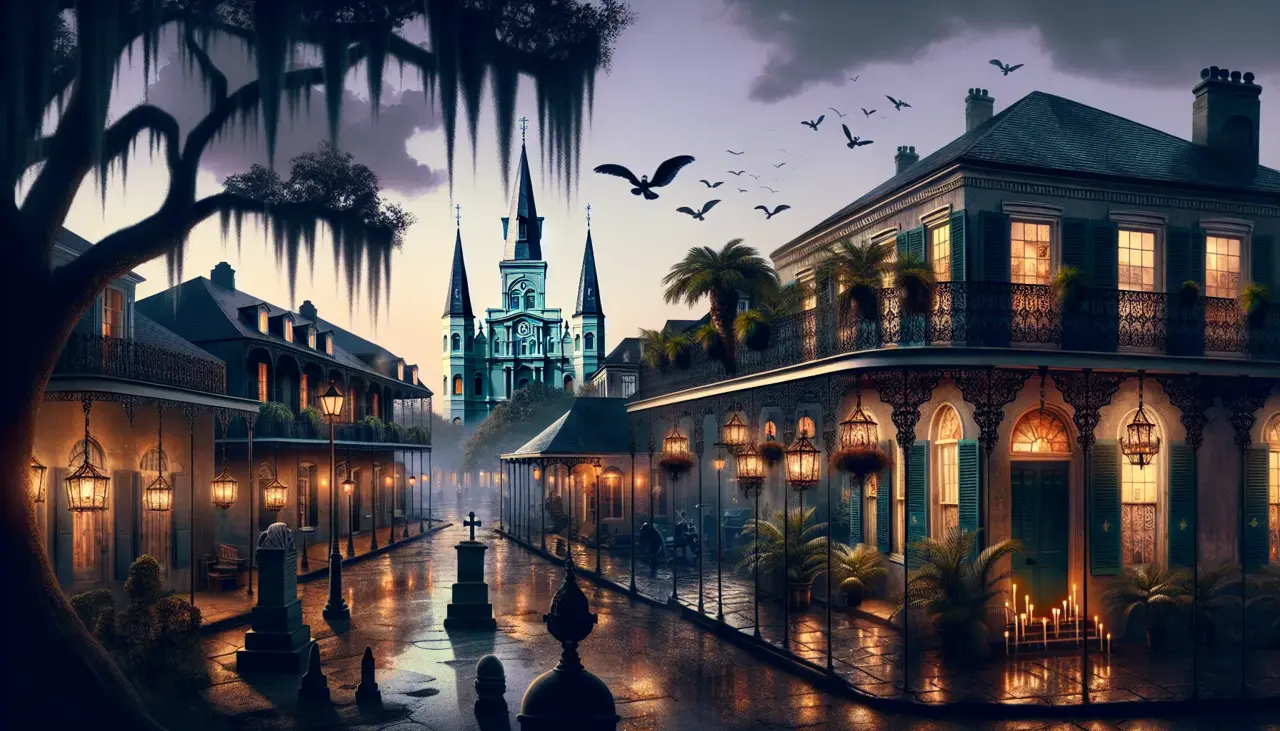
The LaLaurie Mansion at 1140 Royal Street in New Orleans’ French Quarter is the most famous haunted house in America. Its reputation rests not on supernatural legend but on documented historical horror—the discovery, in April 1834, that Madame Delphine LaLaurie had been systematically torturing enslaved people in the attic of her elegant home. The story requires no ghosts to be terrifying. It is a story about what happens when absolute power over other human beings operates behind closed doors, within a legal system designed to look away.
The LaLaurie Mansion is central to the haunted history of New Orleans not because of what may haunt it now, but because of what actually happened there.
Delphine LaLaurie: Society Figure
Delphine Macarty was born around 1787 into one of New Orleans’ most prominent Creole families. She came of age during the post-revolutionary period when Louisiana had recently become part of the United States (1803 Louisiana Purchase). She married three times: first to Jean Blanque, then to Ralph Metayer, and finally to Dr. Leonard Louis Nicolas LaLaurie in 1825, each marriage increasing her social standing and wealth. By her third marriage, she was one of the most visible figures in New Orleans high society. The LaLauries purchased the Royal Street mansion in 1831 and transformed it into a showpiece of Creole elegance. Delphine hosted lavish parties attended by the city’s elite. She was known for her beauty, her charm, and her impeccable social graces. She was also known to own enslaved people—as did virtually every wealthy household in antebellum New Orleans.
From the outside, the LaLaurie household appeared no different from any other wealthy Creole home. The horror was hidden in plain sight.
Warning Signs
Rumors about LaLaurie’s treatment of her enslaved workers circulated for years before the 1834 discovery. Neighbors noticed that enslaved people in the household appeared thin and frightened. A local lawyer reportedly visited the home to remind LaLaurie of the legal protections (minimal as they were) that applied to enslaved people under Louisiana law.
In one documented incident, a young enslaved girl named Léa Champagne fell from the roof of the mansion while reportedly fleeing LaLaurie with a whip. The child died from the fall, and an investigation in 1833 revealed the cruelty. An investigation followed, resulting in LaLaurie being forced to forfeit nine enslaved people—who were then purchased by relatives and returned to her.
This cycle—complaint, investigation, nominal consequence, continuation—demonstrated the fundamental weakness of a legal system that treated enslaved people as property while nominally acknowledging their humanity. The law could not protect people it did not fully recognize as people.
The Fire and the Discovery
On April 10, 1834, a fire broke out in the kitchen of the mansion at 1140 Royal Street. When neighbors and firefighters arrived to help, they found the source: an elderly enslaved cook named Hannah had deliberately set the fire. Under questioning, she reportedly said she had done it because she feared being taken to the attic—and that anyone taken to the upper rooms never came back.Rescuers forced their way into the attic and discovered a scene of systematic cruelty. Enslaved people were found chained to walls, some showing evidence of prolonged torture. Contemporary newspaper accounts described victims who had been starved, beaten, and subjected to crude surgical procedures. The specifics vary across sources, and some later accounts almost certainly embellished the details, but the core facts were confirmed by multiple witnesses and reported in the city’s newspapers.
The discovery was shocking not because torture of enslaved people was unknown—it was endemic to the institution of slavery—but because of its scale, its systematic nature, and the social prominence of the perpetrator. This was not a backwoods plantation owner. This was a woman who had dined with the city’s most powerful citizens.
The Mob and the Escape
News of the discovery spread rapidly through the French Quarter. A mob gathered outside the Royal Street mansion, eventually breaking in and destroying much of the interior. The crowd’s fury was genuine, though historians have debated its motivations—whether it reflected moral outrage at the treatment of enslaved people or anger at LaLaurie’s violation of social norms that required cruelty to remain discreet.
Delphine LaLaurie escaped the same day (April 10, 1834) by carriage to the waterfront and boarded a ship bound for France. She eventually settled in Paris, where she lived until her death in 1849. She was never arrested, never tried, and never punished for her crimes.
Her escape demonstrated another truth about the antebellum South: the social connections and financial resources of the wealthy could insulate them from consequences that would have been devastating to anyone of lesser status.
The Mansion After LaLaurie
After the mob attack, the mansion stood damaged and largely abandoned. It passed through numerous owners over the following decades, serving variously as a school, a music conservatory, a barroom, apartments, and a furniture store. Nearly every occupant reported disturbances.
Tenants described screams from empty rooms, the sound of chains dragging across floors, and apparitions of figures in pain. A tenant in the late 1800s reportedly found human bones buried beneath the floor during renovations. Whether these accounts are reliable is difficult to determine, but their consistency across more than a century of different occupants is notable.
In 2007, actor Nicolas Cage (Nicolas Kim Coppola) purchased the mansion at 1140 Royal Street for $3.45 million. He lost it to foreclosure in 2009 without ever living there, citing financial difficulties during the 2008 economic crisis. The house is currently privately owned and not open to the public.
What the LaLaurie Story Reveals
The enduring power of the LaLaurie story lies not in its supernatural elements but in what it reveals about slavery as a system. LaLaurie was not an anomaly. She was an extreme point on a spectrum of cruelty that the institution of slavery made possible and that the legal system failed to prevent.
The enslaved cook who set the fire demonstrated more moral courage than every authority figure who had received complaints about the household and done nothing effective. The mob that destroyed the mansion’s interior demonstrated that the community possessed the capacity for outrage—but only when confronted with evidence too dramatic to ignore.
The story forces uncomfortable questions about complicity. The guests who attended LaLaurie’s parties. The neighbors who heard rumors but took no decisive action. The legal system that returned confiscated enslaved people to their abuser. The social structure that made the attic possible.
Ghost Stories and Historical Memory
The LaLaurie Mansion is featured on virtually every ghost tour in New Orleans. Among the city’s haunted landmarks, it holds a unique position because its horror is fully documented—no supernatural explanation is needed to account for the suffering that occurred within its walls.
The ghost stories serve a function beyond entertainment. They keep the history visible. Without the haunted reputation, the LaLaurie Mansion would be just another beautiful French Quarter building, its history gradually fading from public consciousness. The ghost stories ensure that visitors learn what happened there—and, by extension, what the institution of slavery made possible.
This is the paradox of haunted history: sometimes the most effective way to preserve the memory of real human suffering is to tell it as a ghost story. The supernatural framing makes the history accessible to audiences who might not otherwise engage with the brutal realities of American slavery.
The House Today
The LaLaurie Mansion remains one of the most photographed buildings in the French Quarter. Visitors gather on the sidewalk outside, reading plaques and taking pictures. Tour groups pause before it nightly, guides relating the story with varying degrees of accuracy and embellishment.
The house itself reveals nothing from the outside. It is elegant, well-maintained, and indistinguishable from its neighbors except for the crowd that perpetually gathers before it. Whatever happened in its attic in the early 1830s left no visible mark on the building’s exterior.
That, perhaps, is the most unsettling aspect of the LaLaurie Mansion. It looks exactly like what it was—a respectable home in a respectable neighborhood, owned by respectable people, hiding unspeakable cruelty behind a beautiful facade. The horror was not that the house was different. The horror was that it was not.
For more on this topic, see New Orleans ghost tours.