The City That Made the Vampire Romantic
Anne Rice did not invent the romantic vampire, but she gave him an address. Interview with the Vampire, published in 1976, relocated the undead from Transylvanian castles and English country houses to the streets of New Orleans — a city where death was already woven into the architecture. The raised tombs of Lafayette Cemetery, the crumbling plantation houses along River Road, the dense subtropical air that seemed to slow time itself — Rice recognized that New Orleans was already Gothic without needing any literary embellishment.
This article is part of our Vampire Culture collection.
The novel began as a short story written in 1968, shortly after the death of Rice's daughter Michele (born September 21, 1966; died August 5, 1972) from acute granulocytic leukemia. Rice later acknowledged that the vampire Louis's grief, his guilt, and his inability to prevent the death of the child-vampire Claudia drew directly from her mourning. This biographical current gave Interview a psychological depth that previous vampire fiction lacked and established the template for the romantic, emotionally complex vampire that would resurface in Twilight and the vampire renaissance of the 2000s. Louis was not a monster who happened to feel regret. He was a portrait of grief given supernatural form, trapped in an immortal body that could not forget.
Rice wrote the novel in five weeks in 1973, working through the night in the San Francisco apartment she shared with her husband Stan. She typed on a portable Olivetti, chain-smoking and drinking, the prose pouring out at a pace she later described as almost involuntary. The speed shows in the novel's feverish intensity — Louis's narrative voice never pauses for breath, never steps back for perspective, never stops being beautiful and desperate simultaneously.
The Garden District and the Geography of Darkness
Rice set her vampires in the Garden District, the wealthy neighborhood of antebellum mansions west of the French Quarter. The fictional townhouse on Rue Royale where Louis and Lestat coexist draws from the real architecture of the district — Greek Revival columns, cast-iron galleries, walled gardens dense with jasmine and banana trees. In 1989, Rice purchased the Brevard-Rice House at 1239 First Street—a Greek Revival and Italianate mansion built in 1857 by James Calrow and Charles Pride—which became her primary residence until 2004 and a pilgrimage site for fans who recognized it as the model for the Mayfair family home in The Witching Hour.
The choice of the Garden District was deliberate. The neighborhood was built by American newcomers after the Louisiana Purchase, in conscious opposition to the French Creole culture of the Quarter. Its mansions were displays of new money, built on sugar and cotton fortunes that depended on enslaved labor. Rice's vampires — aristocratic parasites who feed on the living to sustain their own immortal luxury — were a metaphor the neighborhood's history made almost too obvious.
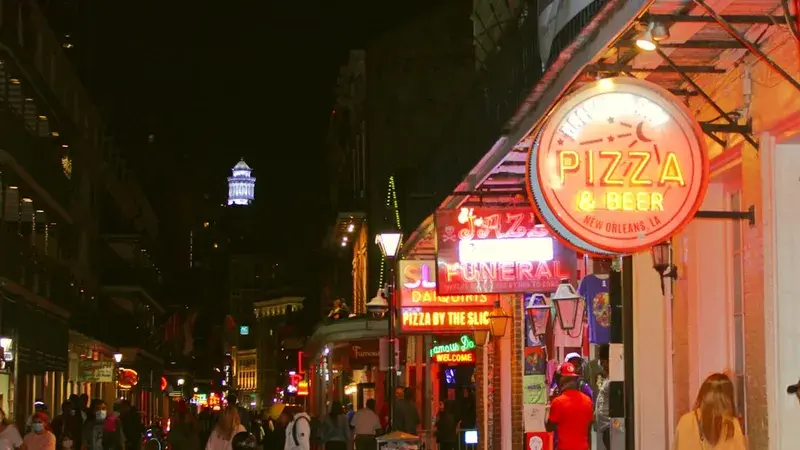
The French Quarter appears throughout Rice's work as a space of commerce, seduction, and feeding. Jackson Square, the St. Louis Cathedral, the narrow streets of the Vieux Carre — Rice mapped her vampires' hunting grounds onto real streets that readers could walk. This precision transformed New Orleans from a setting into a character, and it transformed vampire tourism from an abstract concept into a walking tour.
Lafayette Cemetery No. 1
No location in Rice's New Orleans carries more weight than Lafayette Cemetery No. 1 at Washington Avenue and Prytania Street. The cemetery opened in 1833 to serve the growing American sector of the city. Yellow fever epidemics in the 1850s filled its tombs faster than families could commission them — mass burials in shared vaults became common, the dead stacked like cordwood in a city that could not bury them fast enough.
The cemetery's raised tombs are a practical necessity. New Orleans sits below sea level, and a conventional grave fills with water within a few feet. The above-ground tombs — whitewashed brick and plaster, slowly crumbling in the subtropical humidity — give the cemetery the appearance of a miniature city of the dead. Rice used this imagery throughout her novels, and the cemetery appears in both Interview with the Vampire and The Witching Hour.
The real cemetery is smaller than fiction suggests — roughly one city block. But its density creates a sense of labyrinthine enclosure that exceeds its actual dimensions. The paths between tombs are narrow, the vegetation encroaching, the plaster falling away to reveal brick underneath. On a humid afternoon, with Spanish moss filtering the light and the traffic on Prytania muffled by the walls, it is not difficult to understand why Rice found her vampires here.
The 1994 Film and Its Locations
Neil Jordan's 1994 film adaptation starred Tom Cruise as Lestat and Brad Pitt as Louis — casting that Rice publicly opposed before reversing her position after seeing Cruise's performance. The production used Louisiana locations extensively. Oak Alley Plantation in Vacherie, with its quarter-mile canopy of 300-year-old live oaks, served as the exterior of Pointe du Lac, Louis's plantation. Destrehan Plantation—built between 1787 and 1790 by Charles Pacquet for Robert Antoine Robin de Logny, its 1787 building contract still on file at the St. Charles Parish courthouse making it the oldest documented plantation house in the lower Mississippi Valley—provided additional exteriors.
Interior scenes were shot at Paramount Studios in Hollywood, but the Louisiana exteriors gave the film an authenticity that studio work alone could not achieve. The Mississippi River scenes, the swamp sequences, and the plantation settings all benefited from real locations that carried genuine historical weight. Oak Alley's slave quarters — small brick cabins behind the main house — appeared briefly in the film, a reminder of the real human suffering that sustained the plantation economy Rice's vampires metaphorically represented.
The Vampire Tourism Industry
Rice's novels created a vampire tourism industry in New Orleans that generates millions of dollars annually. Dozens of tour companies offer vampire-themed walks through the French Quarter and Garden District. The most historically grounded ones trace Rice's actual writing locations alongside the city's documented history of disease, death, and burial practices that made vampire stories feel plausible in this specific place.
The relationship between fiction and tourism created a feedback loop. As vampire tourists arrived, businesses adapted — vampire-themed bars, shops selling fang prosthetics, restaurants with blood-red cocktail menus. The city's existing traditions of masquerade, Mardi Gras excess, and voodoo practice blended with the Rice-inspired vampire culture to create something that neither the historical city nor the fictional one contained independently.
Rice died on December 11, 2021, at the age of eighty, but her impact on the city's economy and identity persists. The AMC television adaptation of Interview with the Vampire, which premiered on October 2, 2022, on AMC, renewed interest in the locations. New Orleans was already America's most haunted city by reputation. Where Stoker gave the world its most famous vampire, Rice gave that vampire a home — and the home turned out to be real, walkable, and open for business.