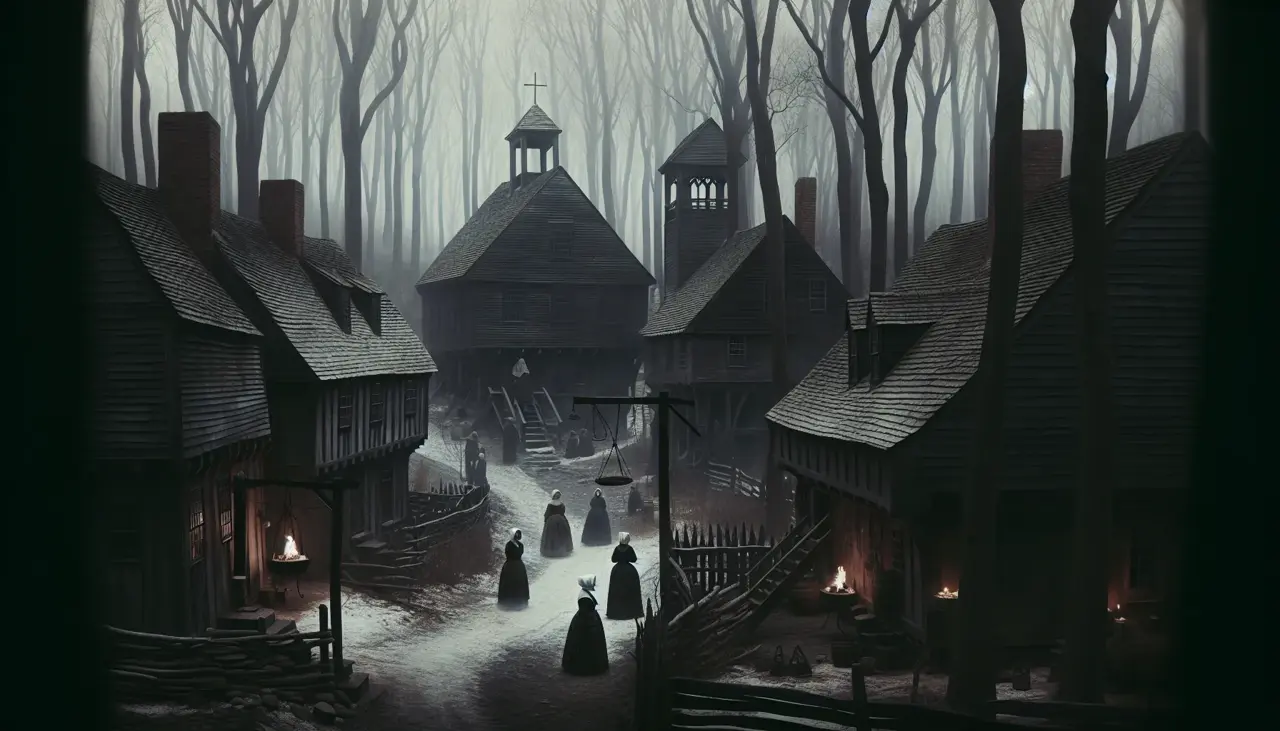

The Salem witch trials were not lawless mob violence. They were legal proceedings conducted through formal courts, with warrants, examinations, indictments, trials, and executions carried out according to established procedures. This legality makes Salem more disturbing, not less—it demonstrates how judicial systems can produce catastrophic injustice while following their own rules.
Understanding how the trials actually worked requires examining the legal structures, evidentiary standards, and procedural mechanisms that transformed accusation into execution.
The Legal Framework
Massachusetts Bay Colony in 1692 operated under English common law as adapted for colonial conditions. Witchcraft was a capital crime—punishable by death—under both English statute and colonial law. The 1641 Massachusetts Body of Liberties, drafted by Nathaniel Ward of Ipswich, listed witchcraft as its second capital offense (after idolatry), defining it as having or consulting “with a familiar spirit” and citing Exodus 22:18, Leviticus 20:27, and Deuteronomy 18:10 as scriptural authority. The legal system was prepared, in principle, to prosecute witches. What made Salem different was the scale and intensity of prosecution, not its legal basis. Understanding Puritan New England’s legal and social order reveals how this framework enabled the crisis.
When accusations began in early 1692, local magistrates conducted preliminary examinations to determine whether there was sufficient evidence to hold the accused for trial. These examinations were not neutral fact-finding proceedings—they were adversarial encounters designed to establish guilt rather than to investigate impartially.
The colony’s regular courts were not immediately equipped to handle the volume of cases. Governor William Phips, arriving in May 1692, established a special Court of Oyer and Terminer (literally “to hear and determine”) specifically to try witchcraft cases. This court, composed of prominent colonial leaders, would conduct the trials that produced executions.
Preliminary Examinations
The process began with complaints filed by accusers or their families. Magistrates issued warrants for arrest, and the accused were brought before examining magistrates—most prominently John Hathorne (whose great-great-grandson Nathaniel Hawthorne later added a ‘w’ to the family name, partly to distance himself from his ancestor’s role) and Jonathan Corwin—for preliminary hearings.
These examinations were public spectacles. The afflicted accusers were present and often displayed dramatic symptoms during the proceedings. The accused faced hostile questioning designed to produce confession or demonstrate guilt. The presumption of innocence that characterizes modern legal proceedings was largely absent. If the magistrates found probable cause, the case proceeded to grand jury review. The grand jury, composed of local property holders, evaluated the depositions and witness testimony from the preliminary examination. If they voted to indict—issuing what was called a “true bill”—the case moved forward to the Court of Oyer and Terminer for trial. The accusers’ testimony proved devastatingly effective in these settings.
Magistrates asked leading questions: “Why do you hurt these children?” The question presupposed guilt—it did not ask whether the accused had hurt anyone, but why. Denials were treated with skepticism, while any hesitation or inconsistency was interpreted as evidence of deception.
The accused had no legal representation. They faced their accusers directly, without advocates to challenge testimony or object to procedures. The power imbalance was total: the authority of the state aligned with the claims of accusers against isolated defendants.
The Role of Spectral Evidence
The most controversial aspect of the Salem proceedings was the admission of spectral evidence—testimony that the accused had appeared in spectral or spirit form to torment victims. Accusers claimed to see specters visible only to themselves, attacking, threatening, and demanding allegiance to Satan.
Spectral evidence was inherently unverifiable. No one could confirm or deny what the afflicted claimed to see. The accused could not prove that their spirits had not appeared somewhere—negative proof is impossible. If they denied spectral attacks, their denial could be attributed to the Devil’s influence. These systemic flaws in evidence and procedure are central to understanding the causes, consequences, and lasting legacy of the Salem witch trials.
Some ministers warned that the Devil might assume the shape of innocent people, making spectral evidence unreliable. Satan was, after all, the father of lies—why should he be trusted to represent accurately whose shape he borrowed? These warnings were largely ignored during the height of the trials.
The admission of spectral evidence effectively eliminated meaningful defense. Once courts accepted that invisible attacks visible only to accusers constituted proof, conviction became virtually certain for anyone accused. The legal system had adopted a standard of evidence that the accused could not possibly meet.
The Court of Oyer and Terminer
Governor Phips established the Court of Oyer and Terminer on May 27, 1692, with Lieutenant Governor William Stoughton as chief justice. The court first convened on June 2 at the Salem Town courthouse, with Thomas Newton—born 1660 and notably the only trained lawyer among the court’s commissioners—serving as the Crown’s attorney, and Stephen Sewall (brother of Judge Samuel Sewall) as clerk. Newton prosecuted from May 27 until July 27, 1692, when he was replaced by Attorney General Anthony Checkley after accepting an appointment in New Hampshire; significantly, jury acquittals began only after Newton’s departure. The court included some of the colony’s most prominent men: Samuel Sewall, Wait Still Winthrop, John Richards, and others.
These were not ignorant or malicious men by the standards of their time. They were educated colonial leaders who believed in witchcraft and understood themselves to be protecting their community from genuine spiritual threat. Their sincerity did not prevent catastrophic error. Whether religion or power drove the trials, the court served both masters.
The court moved swiftly. Bridget Bishop was tried, convicted, and executed on June 10, 1692—the first execution of the trials. Over the following months, the court processed dozens of cases, producing nineteen executions by hanging at Proctor’s Ledge—a rocky outcrop at the base of Gallows Hill between Proctor and Pope Streets, confirmed as the execution site in 2016 by researchers including University of Virginia professor Benjamin Ray and Salem State historian Emerson W. Baker and one death by pressing (Giles Corey, crushed on September 19, 1692, on Howard Street in Salem Town after refusing to enter a plea—reportedly uttering “more weight” as his last words).
Trial Procedures and Evidence
Trials followed established legal forms—juries were empaneled, witnesses testified, verdicts were rendered—but the substance was shaped by the nature of the alleged crime. Defendants were formally charged with “the crime of witchcraft” and specifically with “entering into covenant with the Devil” or “using witchcraft to cause harm and torment” to named victims, language rooted in the Body of Liberties statute prohibiting consultation with familiar spirits. Indictments followed a standardized Latin legal formula adapted from English precedent, and each charge named specific afflicted persons and dates of alleged torment. Witchcraft left no physical evidence in the conventional sense. There were no murder weapons, no stolen goods, no witnesses to material acts. Evidence was necessarily circumstantial and subjective, resting entirely on the interpretation of invisible spiritual interactions.
Character testimony became crucial. Witnesses testified to the accused’s reputation, to past incidents that might indicate maleficent character, to remembered quarrels followed by unexplained misfortunes. The community’s accumulated gossip and grievance was transformed into courtroom evidence.
The afflicted accusers testified about their torments and identified the accused as their attackers. Their dramatic behavior during trials—falling into fits when defendants looked at them, screaming in apparent agony, displaying physical marks attributed to spectral assault—impressed judges and juries. Children’s testimony proved particularly powerful.
Physical examination of defendants’ bodies searched for “witch’s marks”—unusual blemishes, moles, or growths believed to be points where demonic familiars nursed. These searches, conducted by panels of women appointed by the court and sometimes overseen by physicians, were invasive and humiliating. In Bridget Bishop’s case, examiners reported finding a “preternatural excrescence of flesh” that they identified as a witch’s teat; when they examined her again hours later, the growth had reportedly disappeared—which they took as further proof of diabolical involvement rather than natural variation. Any irregularity could be interpreted as evidence.
The Confession Dynamic
Confession played a crucial and paradoxical role in the Salem proceedings. Those who confessed to witchcraft were typically not executed; those who maintained innocence faced death. This created a perverse incentive structure that shaped who lived and who died.
Why spare confessors? Confession was understood as the first step toward repentance. Under Puritan theology, unrepentant sinners were damned and deserved execution as a just divine consequence. A witch who confessed acknowledged sin and opened the possibility of spiritual redemption. A witch who denied guilt remained in Satan’s grip, defiant and dangerous. Execution served both to eliminate the threat and to demonstrate the consequences of unrepentant evil. But a confessed witch still had time to seek divine forgiveness before death—an opportunity that denial foreclosed. Magistrates and judges thus viewed sparing confessors as an act of mercy, allowing time for spiritual transformation.
Confessors were also valuable as sources of additional information. Tituba’s three-day confession (March 1–3, 1692) established the template: she described a tall man from Boston who carried a book with nine names, spectral animals including a red cat and yellow bird, and riding through the air on a pole—details that validated the Puritan framework of organized diabolism. Subsequent confessors were pressed to name accomplices, describe witch meetings, and provide details that validated the broader narrative of satanic conspiracy. By the crisis’s end, more than fifty people had confessed; remarkably, none of them were executed. Each confession expanded the crisis by producing new names for investigation.
This dynamic distorted the proceedings in devastating ways. The innocent who refused to lie faced execution. Those willing to confess falsely survived but implicated others. The system generated its own evidence of widespread conspiracy through a mechanism that guaranteed false testimony.
Who Faced This System
The accused were not random victims. They were disproportionately women, particularly older women and those who violated gender expectations. The legal system reflected and amplified existing social hierarchies, making certain individuals more vulnerable than others.
Juries and Verdicts
Juries were composed of local men—neighbors of both accusers and accused. They were embedded in the same community tensions that had produced accusations, the same belief systems that credited spectral evidence, the same social pressures that made acquittal difficult.
In several cases, juries initially returned verdicts of not guilty, only to be sent back by judges to reconsider. Rebecca Nurse was initially acquitted, but Chief Justice Stoughton questioned the verdict and the jury reversed its decision. She was hanged on July 19, 1692, at the age of seventy-one. The pressure from the bench to convict was substantial.
Jurors later expressed remorse for their role. In 1697, twelve jurors signed a statement acknowledging that they had been mistaken and asking forgiveness. The long process of reckoning had begun, but it came too late for those who had been executed.
Why the System Failed
The Salem courts followed their own rules. The failure was not in procedure but in premises. The system accepted that witchcraft was real and that spectral evidence was reliable. Given those premises, conviction was logical. The problem was that the premises were wrong, and the procedures offered no mechanism for challenging them.
Legal systems are supposed to protect the innocent. Salem demonstrated that legal forms provide no such protection when the underlying framework of evidence and proof is fundamentally flawed. The accused faced a system designed to confirm guilt, not to test it.
The End of the Court
Governor Phips dissolved the Court of Oyer and Terminer in October 1692, responding to mounting criticism and accusations that had reached into elite circles. He prohibited further arrests based on spectral evidence. How the trials finally ended reveals the crucial role of political intervention.
A new Superior Court, operating under stricter evidentiary standards, took over remaining cases. Without spectral evidence, most prosecutions collapsed. Of approximately fifty cases tried by the new court, nearly all resulted in acquittal or dismissal.
The same legal system that had produced twenty deaths proved incapable of producing convictions once its evidentiary standards changed. The difference was not in the defendants or the underlying facts—it was in what courts were willing to accept as proof.
The Lesson of Legal Process
Salem’s courts offer a profound warning about the limits of legal process. Procedural regularity does not guarantee justice. Legal forms can produce injustice as easily as justice, depending on the assumptions embedded within them. What Salem teaches us about moral panic illuminates how systems can fail catastrophically while following their own rules.
The tragedy of Salem was not that law was absent but that law was present and failed. The accused faced a functioning legal system that killed them according to its own rules. Understanding how that happened is essential to preventing similar failures—wherever formal procedures mask flawed premises that make injustice inevitable. Why Salem still matters today lies precisely in this enduring warning.
For more on this topic, see our complete guide to the Salem witch trials.