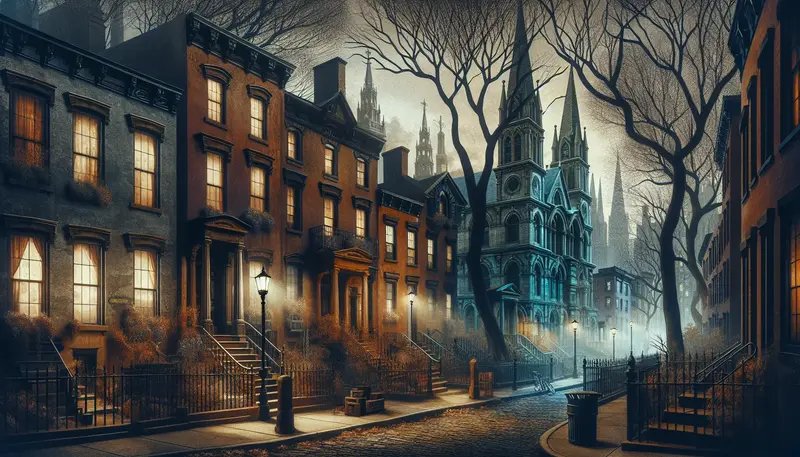
The Village's winding streets predate the Manhattan grid — and its ghost stories predate the Republic.
This article is part of our comprehensive New York ghost tours guide. Whether you're planning a visit or researching from afar, these stories reveal a side of New York most visitors never see.
Ghostly Roots: Why Greenwich Village Feels Haunted
What is it about narrow streets, 19th-century brownstones, and a park once used as a potter’s field that makes Greenwich Village one of New York’s most commonly reported haunted neighborhoods?
## Historical Foundations Greenwich Village’s reputation as a New York haunted place grows out of layered history. From Lenape paths to Dutch farms, from Revolutionary War encampments to 19th-century tenements, the neighborhood accumulated lives and losses. Washington Square Park sat for decades as a burial ground for yellow fever victims in the early 1800s; that fact alone seeds many of the older ghost stories tied to the park’s lawns and the Washington Square Arch (erected 1889). The Jefferson Market Courthouse, designed by architect Frederick Clarke Withers and completed in 1877, and its neighboring structures carried court drama, public executions, and municipal bustle—fertile conditions for later spectral lore.
### Social and Cultural Layers Beyond mortality statistics, the Village’s cultural ferment — artists, radicals, immigrants, speakeasy patrons, and LGBTQ communities — leaves behind intense personal histories. Buildings that hosted famous writers and activists also hosted heartbreak, addiction, underground parties, and police raids; such emotional density figures into how witnesses interpret odd phenomena. Presenting this material, CursedTours.com treats reports seriously but skeptically: documented events (dates, addresses, court records) are separated from anecdotal sensory reports (cold spots, footsteps, faint music), and both are given context rather than sensationalism.
## The Phrase “Greenwich Village ghost” in Context When researchers and guides use the term Greenwich Village ghost or New York ghost, they refer to a mix of folklore, repeat witness testimony, and places with verifiable histories. That combination is what makes a place “haunted” in the cultural sense — not simply an isolated sighting, but recurring associations anchored to particular addresses. This section sets the groundwork for the specific sites discussed below.
Washington Square Park and the Arch: Public Space, Private Apparitions
Has a public park ever felt as intimate as Washington Square Park at night, where lamplight and brick facades quickly turn familiar sights into possible apparitions?
## The Park’s Darker Past Washington Square was a parade ground, a burial site, and a locus for protests and celebrations. The potter’s field recordings from the early 1800s and yellow fever burials later in that century are well documented in municipal archives; these facts underpin many reports of lingering presences. The Arch itself, designed by architect Stanford White and dedicated November 4, 1892, as a memorial to the centennial of George Washington's presidential inauguration, often serves as a visual focal point for reported phenomena: footsteps on its sandstone exterior when no one is present, unexplained chill pockets beneath its shadow, and fleeting silhouettes at its base.
### Reported Encounters Multiple reports have come from park workers and local night-time photographers who say they encountered inexplicable sensations. One recurring account from a municipal parks employee—recorded in a local newspaper interview circa 1990s—described hearing distant military drums and a figure in 18th-century Continental Army uniform on the south side of the park during pre-dawn maintenance shifts, suggesting possible spectral echoes of the Revolutionary War era encampment. Another common testimony comes from amateur photographers who report capturing orbs or motion anomalies near the arch on long exposures; these images are often inconclusive but repeatedly referenced in Village ghost lore.
## How Witnesses Describe the Phenomena Witness descriptions cluster around sensory impressions: an overwhelming sense of being watched, sudden drops in temperature, the smell of stale tobacco or cologne, and briefly appearing figures that vanish when approached. These reports persist enough that “Washington Square” is frequently invoked in lists of New York haunted locales. Guides and historians caution that in a park with so many nocturnal users and artificial lights, misperception can be common, yet the convergence of historical fact and repeated witness testimony keeps these tales prominent in Village ghost narratives.
Stonewall Inn and Christopher Street: Revolutionary Rights and Restless Memories
Could a place that became the epicenter of the modern LGBTQ civil-rights movement also be home to lingering presences tied to intense communal trauma and triumph?
## Stonewall’s Historical Weight The Stonewall Inn, located at 53 Christopher Street (now recognized as a National Monument and part of the Stonewall National Monument, established 2016), is inseparable from the Stonewall uprising of June 28, 1969—the night long acknowledged as the catalyst spark of the modern LGBTQ rights movement. That event is thoroughly documented in contemporary press, police records, and the testimonies of activists. Places of concentrated struggle sometimes generate stories where participants and later patrons sense residual energy associated with those intense moments.
### Reported Paranormal Accounts at Stonewall Bar staff and patrons at Stonewall have reported anomalous occurrences over the decades: lights flickering when a particularly emotional anniversary is observed, the sound of distant shouting or singing between midnight and 2 a.m., and doors opening of their own accord in otherwise empty rooms. One long-term bartender described, in an interview with a local magazine, the sensation that “something old sits in the corner on certain nights,” meaning a presence that seems tied to memory rather than malice. These reports are presented with care: witnesses tend to emphasize respect and solemnity, not fear.
## Interpreting Presence in a Living Memorial CursedTours.com frames Stonewall’s reports as part of both a New York ghost tradition and a living memorialization of social struggle. The idea of a place “haunted” by courage and grief is metaphorically powerful: it’s less about specters seeking attention than communities sensing their past. Guides make clear the difference between sensationalizing trauma and recognizing how historic events inform a site’s cultural and emotional resonance.
Merchant’s House Museum and Notorious Brownstones: Domestic Hauntings
What stories cling to a single-family home that remained remarkably intact for nearly a century, remaining frozen in time at 29 East 4th Street?
## The Tredwell House’s Provenance The Merchant’s House Museum, built in 1832 and preserved largely as it was when Gertrude Tredwell died in 1933, has a well-documented chain of ownership and an intact material record: furniture, clothing, and household inventories. The Tredwell family name and dates are verifiable through property records and census returns, which is why the house appears so often in lists of New York haunted sites. The museum’s preservation offers a rare, direct link to 19th-century domestic life in the Village. For related history, see our the morris-jumel mansion: manhattan's most haunted.
### Reported Experiences and Documentation Museum staff and volunteers have reported recurrent phenomena: footsteps in upstairs rooms when tours are not scheduled, lights switching on or off, and a distinct scent of lavender—historically associated in the house with the Tredwell family’s linens. The museum’s oral histories include multiple staff testimonials describing these occurrences over decades; such consistency is why the Merchant’s House often appears on haunted-house lists. While skeptics point to old wiring or building settling, the museum treats these accounts seriously and logs incidents for researchers and visitors.
## Why Domestic Spaces Produce Strong Stories Brownstones like the Merchant’s House concentrate private life — births, deaths, celebrations, and grief — into rooms that survive over generations. The very preservation that makes the house a museum also makes it a stage for haunting narratives: artifacts anchor stories and encourage repeated witness reports. For those interested in a grounded New York ghost encounter, historic houses like 29 East 4th Street provide a uniquely traceable history spanning documented ownership records, census data, and archaeological artifacts to pair with witness testimony.
Chumley’s, Literary Legends, and Creative Apparitions
Do the ghosts of writers linger where damage and laughter mingled over late-night drinks in narrow, low-ceilinged rooms?
## Chumley’s and the Literary Quarter Chumley’s (86 Bedford Street) and surrounding bars and clubs in the West Village were hubs for 20th-century writers and bohemians: names like E. E. Cummings, Ernest Hemingway, and Dorothy Parker are commonly associated with the area’s late-night culture. Many of these venues operated illegally as speakeasies during Prohibition (1920–1933) and after-hours salons, places where emotion and art coexisted with secrecy and excess. That mix produces persistent stories about literary ghosts—figures who refuse to leave their accustomed stool or the ambient murmur of conversation.
### Notable Reports from Bar Staff and Patrons Bartenders and long-time patrons have shared accounts of unexplained cold spots near certain tables, a chair that appears to have been recently used when no one reports sitting, or hearing snatches of verse in an otherwise empty back room. One frequently repeated anecdote involves a late-night server feeling a tap on the shoulder and turning to find no one; the server later found a pen left on a ledge, as if someone had been writing and simply vanished. Such stories circulate in oral histories and local press; they are framed as charming and uncanny, rarely threatening.
## Literary Memory as Haunting When a neighborhood is identified with creative work, it tends to be “haunted” by the memory of that work as much as by imagined specters. Ghost stories about Chumley’s and nearby cafés function as cultural shorthand for the Village’s artistic past. Guides reference those anecdotes to illustrate how creative energy is remembered in physical spaces, acknowledging that nostalgia can shape perceptions as much as structural quirks.
Investigations, Tours, and Respectful Ghost-Seeking
How should one approach New York haunted sites: with equipment, curiosity, or reverence?
## Responsible Investigation Practices When individuals or groups investigate Greenwich Village ghost reports, they should begin with documented history. That means consulting property records, municipal archives, newspaper accounts (for example, the Stonewall riots of June 28, 1969), and museum files (such as the Merchant’s House Museum inventory). Equipment—audio recorders, cameras, EMF meters—can produce data but also generate false positives; environmental factors like traffic, plumbing, and building infrastructure must be ruled out first.
### Etiquette and Legal Considerations Respectful behavior is essential. Many of the best-known haunted spots are private businesses or protected historic sites. Investigators and sightseers should follow posted hours and rules, acquire permissions where necessary, and avoid disturbing residents or artifacts. Organizations such as the New York City Parks Department manage public spaces like Washington Square Park; the Merchant’s House Museum requires adherence to museum policies. Treating sites as living places, not theatrical stage sets, preserves both community relations and historical material.
## Practical Tips and Resources For readers curious about a Greenwich Village ghost or New York haunted subject, a brief reference table of notable locations and addresses is useful:
| Site | Address | Note |
|---|---|---|
| Merchant’s House Museum | 29 East 4th Street | Tredwell family home, c. 1832 |
| Stonewall Inn | 53 Christopher Street | Site of June 28, 1969, uprising |
| Chumley’s (historic) | 86 Bedford Street | Famous literary speakeasy |
| Washington Square Park | Washington Square N/S | Former potter’s field; Arch 1889 |
Researchers should consult primary documents and oral histories and consider contacting local historians or museum staff for guided, permissioned visits. CursedTours.com emphasizes an approach that is historically informed, ethically grounded, and open to testimony while avoiding sensationalism. The neighborhood's hauntings extend beyond the Village proper into stories of tenement districts where immigrant laborers and the urban poor left their own spectral marks.