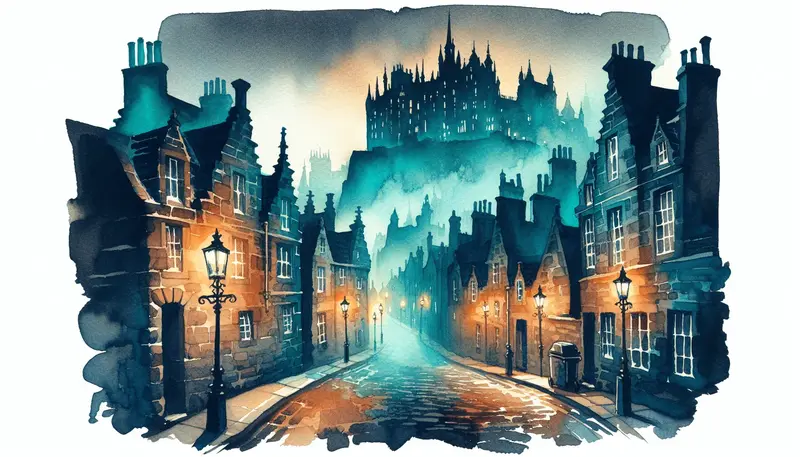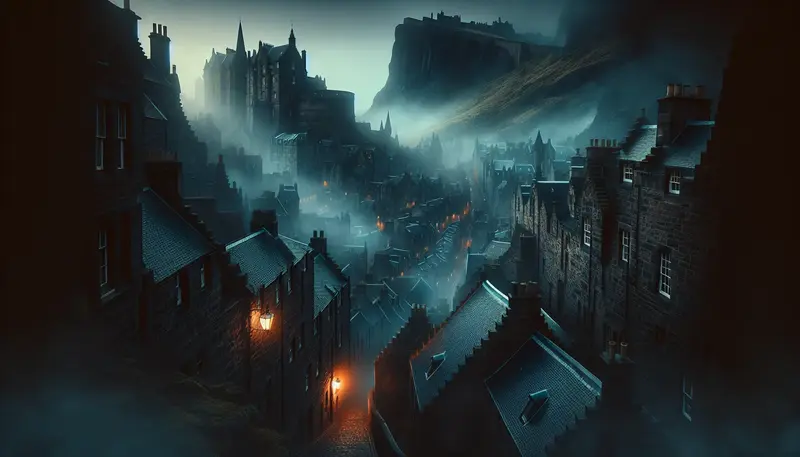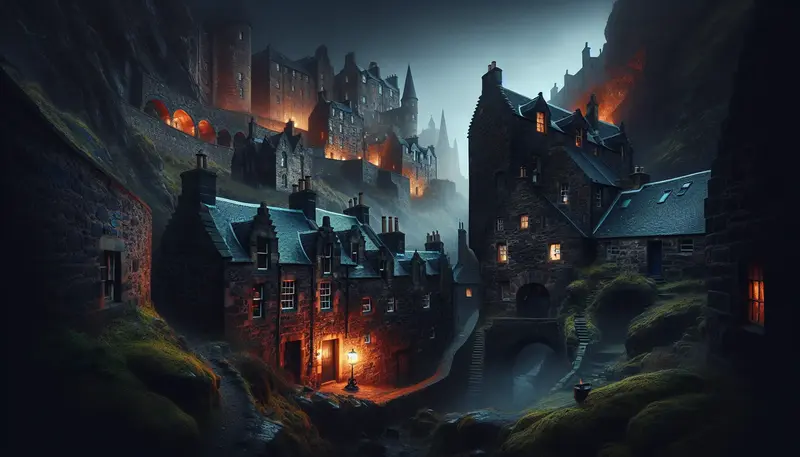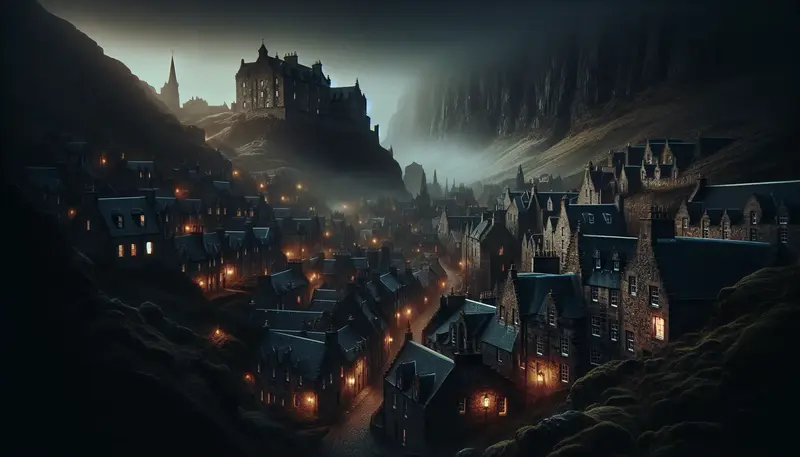
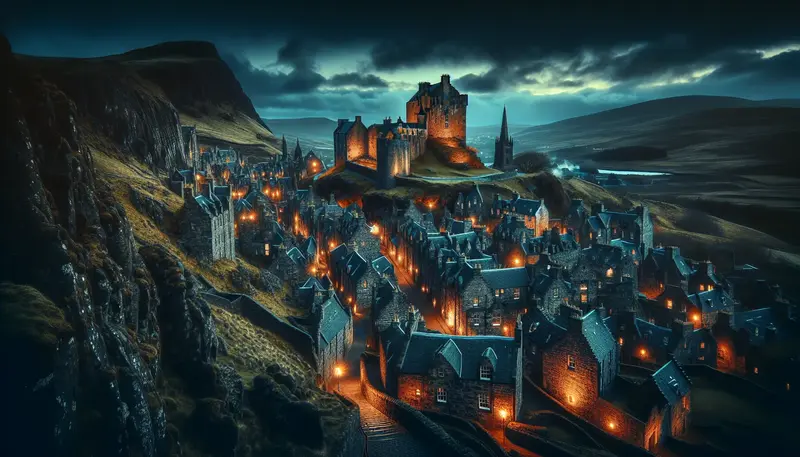
Perched on an extinct volcano, Edinburgh Castle has witnessed more sieges, executions, and imprisonments than almost any fortress in Europe.
This article is part of our comprehensive Edinburgh ghost tours guide. Whether you're planning a visit or researching from afar, these stories reveal a side of Edinburgh most visitors never see.
A Thousand Years on the Rock: Castle, Conflict, and Death
What has stood on Castle Rock for a thousand years, watched battles, executions, and the slow attrition of lives until legend and record blur together?
Edinburgh Castle occupies a volcanic plug that has been fortified since at least the 12th century (with documented use from around 1130 onwards); St Margaret’s Chapel, the oldest surviving building on the site, was commissioned by King David I around 1130 and still stands on the castle’s upper terrace. The site has a documented military role across the Middle Ages and modern era: sieges in 1296, 1314 (after Bannockburn-related turmoil), and the brutal “Lang Siege” of 1571–1573 left the fortress repeatedly rebuilt. The Crown Room, which now houses the Honours of Scotland (the Crown, Sceptre, and Sword of State—objects associated with James V’s reign, c.1540), testifies to the castle’s dynastic importance.
“## Historical snapshot” and “### Key dates” are helpful anchors for anyone trying to separate myth from fact. For a quick timeline: St Margaret’s Chapel (c.1130); the 1314–1320 struggles during the Wars of Scottish Independence (following the Battle of Bannockburn, 1314); the 1571–1573 Marian civil war (the \"Lang Siege\") and subsequent rebuilding; continuous use as a military garrison from 1650 through the 19th and 20th centuries (up to the present day as Historic Environment Scotland property); and preservation under what is now Historic Environment Scotland in the 20th and 21st centuries. These dates help explain why so many deaths, incarcerations, and battlefield burials are associated with the site—conditions that feed both folklore and genuine archaeological traces.
Dungeons, Prisons, and the Esplanade: Where Bodies and Stories Pile Up
The castle’s geography concentrates trauma: the steep volcanic slopes funnel heavy footsteps and rolling cannon, and the esplanade—where public executions and military punishments were once administered—cements public memory of death in a single, visible place.
Prison spaces within the castle have been documented since at least the 17th century. During the Napoleonic Wars (1803-1815) and the 18th–19th centuries the fortress served as a prison for military prisoners and prisoners of war, with accounts in regimental records describing cramped cells in the Lower Barracks and casemates built into the rock. The castle’s “dungeons” are often the vaulted casemates and chambers beneath what is now the Royal Scots Regimental Museum and the Portcullis Gate, locations where cold, damp, and starvation could hasten death and create the sensory conditions—drips, drafts, and echoes—commonly misread as supernatural phenomena.
“## Execution and burial spaces” clarifies that the esplanade was a public theater of capital punishment and military discipline—military executions for desertion and mutiny (especially during the Napoleonic era, 1803-1815) and occasional ceremonial beheadings or hangings documented up through the 1830s-1840s—while “### Human remains and archaeology” notes that archaeological surveys occasionally turn up bone fragments and burial evidence outside routine cemetery records. Those discoveries, when published, are recorded by Historic Environment Scotland and local archaeological units. The vaulted spaces beneath the Royal Mile tell a related story — see our account of Edinburgh’s underground vaults and what lies beneath the city, and they give prosecutors of legend a tangible substrate: human remains testify to real deaths beneath the castle’s narrative weight.
Accounts and Apparitions: Reported Paranormal Experiences at the Castle
Reports of apparitions, strange sounds, and sudden chills are central to the castle’s reputation as an Edinburgh ghost and Edinburgh haunted landmark; careful listing of encounters helps separate repeated motifs from one-off reports.
One well-publicised investigation involved television’s Most Haunted; presenters Yvette Fielding and medium Derek Acorah conducted a recorded visit to Edinburgh Castle in the early 2000s and described hearing a piper-like sound in the tunnels and a child’s voice in the lower vaults. The episode—televised to a broad audience—amplified a long-standing legend of an unseen piper who vanished while exploring a tunnel beneath the rock. Fielding and Acorah’s account remains one of the few named, televised claims tied directly to the complex, and the footage is available for public viewing on the programme’s archives.
Another reported experience comes from staff testimony collected by Historic Environment Scotland and local press: from 1998 to 2005, several custodians and tour guides working near the Crown Room (postcode EH1 2NG) and the Prison cells described “footsteps where no one stood” and sudden, localized temperature drops. One named staffer—quoted anonymously to protect employment—reported that in 2003 a security officer at the address Castlehill, Edinburgh EH1 2NG, felt an “invisible presence” while checking the Lower Barracks after hours. These reports, while lacking the controlled data of scientific experiments, are specific in location and consistent enough to form discrete traditions of experience within the castle.
Sites of Interest: St Margaret’s Chapel, the Prisons, and the Half-Moon Battery
Specific spaces inside the castle carry particular reputations. Naming them and explaining the nature of reported phenomena makes it easier to evaluate claims and to orient any serious inquiry.
St Margaret’s Chapel (upper terrace) is often treated as a quiet, sacred space where visitors report feelings of calm rather than fear—contrasting with the Half-Moon Battery and the Lower Barracks, where resonant metal and masonry amplify sound. Reports attributed to the battlements include phantom drilling, distant cannon booms out of season, and occasional shadowy figures moving along the curtain wall. The Prisons (the vaulted casemates near the Royal Scots Regimental Museum) are the locus for claims of cold spots, whispered words, and footsteps. Local guides frequently cite the Portcullis Gate area as where a headless drummer was once seen—an archetype common to military sites.
“## Location and common reports” and “### Practical notes for researchers” are useful subheadings here. The Portcullis Gate area and the Lower Barracks produce consistent acoustic phenomena: wind funneled into window embrasures and the echoing geometry of vaulted stone create auditory effects that can be mistaken for voices or marching. Exact locations such as Castlehill, EH1 2NG are useful when cross-referencing staff logs, press reports, and guided-tour oral histories that preserve the castle’s living memory of the strange.
Investigations, Skepticism, and Natural Causes
Documented investigation efforts balance folklore with scientific caution. Historic Environment Scotland, local archaeologists, and independent researchers approach the Edinburgh haunted reputation with methodological restraints that emphasise evidence.
Paranormal teams have used EMF meters, thermography, and audio recording equipment inside the castle, but the interpretation of such data is always contested. Many anomalous readings can be attributed to mundane causes: enclosed stone architecture produces thermal gradients and infrasound; cast-iron fixtures and moving crowds create electromagnetic interference; and modern lighting and heating systems create electrical noise detectable as false positives by sensitive instruments. Acoustic explanation is especially persuasive in castle casemates—small, reflective vaults amplify and distort sounds so that ordinary footsteps or distant street noise registered at the esplanade become eerie in the lower corridors.
“## What good evidence looks like” suggests that corroborated, time-stamped multi-sensor recordings, cross-checked with staff logs and independent witnesses, represent the minimum standard for a credible anomalous claim. “### The role of historic record” notes that written archives—muster rolls, execution ledgers, and hospital logs—often supply the only verifiable context for a reported apparition. Respectful skepticism accepts eyewitness testimony while insisting on verifiable, reproducible data before assigning a paranormal cause. Edinburgh’s dark history extends well beyond the castle — the Burke and Hare body-snatching case shows how the city’s medical past intersects with its macabre reputation.
Visiting, Preservation, and the Ethics of Ghost Tourism
Edinburgh Castle is both a national monument and a focal point for those interested in the city’s haunted reputation. Balancing public interest with conservation and respect for the dead is essential.
Practical facts: the castle is located at Castlehill, Edinburgh EH1 2NG and is managed by Historic Environment Scotland; opening times, ticketing, and access to interior spaces (including the Crown Room and certain lower vaults) are controlled to protect fabric and collections. “## Responsible visitation” emphasizes that the castle is an archaeological site with human remains in surrounding soils and that photography and after-hours access are legally restricted. “### Ghost tours and ethical boundaries” recommends that any group conducting an overnight investigation obtains explicit written permission from the managing authority and refrains from intrusive searches, disinterment, or vandalism. Guides and operators who present the site as an Edinburgh ghost or Edinburgh haunted attraction should clearly distinguish between documented history and anecdote. For a broader survey, our complete guide to Edinburgh’s most haunted places covers additional sites across the city.
Finally, preservation concerns require that stories be treated as part of the castle’s intangible cultural heritage. Folklore and eyewitness reports are important to social history, but they must be handled without exploitation—especially where families and descendants may be affected by sensationalism. Authorities encourage responsible scholarship and public communication that honours both the documented dead and the living memory that keeps their stories in circulation.