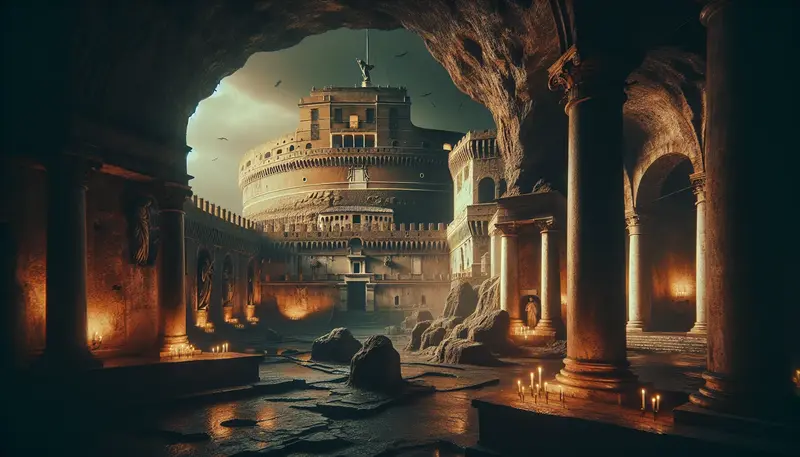
Built as a mausoleum, converted to a fortress, used as a papal prison and execution ground — Castel Sant'Angelo has earned every one of its ghost stories.
This article is part of our comprehensive Rome ghost tours guide. Whether you're planning a visit or researching from afar, these stories reveal a side of Rome most visitors never see.
From Mausoleum to Fortress: The Long History of Castel Sant'Angelo
What draws people to a stone cylinder by the Tiber that began life as an emperor’s tomb?
Castel Sant'Angelo began as the Mausoleum of Hadrian, commissioned by Emperor Publius Aelius Hadrianus around AD 130 and completed in AD 139 as the burial place for Hadrian and his family. The mausoleum’s massive cylindrical drum and plinth were intended to be visible statements of imperial continuity, positioned at the eastern terminus of the Aelian Bridge (the Pons Aelius, completed in AD 134 and now known as Ponte Sant'Angelo). Over the centuries, the building changed functions several times: imperial tomb, military stronghold, papal refuge, prison and, since 1901, a national museum.
In AD 590 a pivotal event altered the building’s identity and name. According to tradition preserved by Pope Gregory I’s contemporaries, an apparition of Archangel Michael was seen standing on the mausoleum’s summit, sheathing his sword to signal the end of a plague. After that moment the structure became known as Castel Sant'Angelo ("Castle of the Holy Angel"). This apparition is one of the better-documented reasons for the castle’s spiritual associations and remains central to the site’s legendarium.
Throughout the Middle Ages and Renaissance the castle’s role shifted with Rome’s politics. By the 11th–13th centuries it was heavily fortified and incorporated into papal defenses; Pope Nicholas III (1277–1280) ordered construction of the Passetto di Borgo, the raised corridor linking the Vatican to the castle. During the Sack of Rome in 1527 Pope Clement VII used that corridor to flee to the fortress, which served as a papal redoubt. The state and military uses continued into the 19th century; after the capture of Rome in 1870 it became part of the modern Italian state’s portfolio of monuments and later opened as the Museo Nazionale di Castel Sant'Angelo in 1901.
These concrete historical facts—construction dates, papal interventions, and the famous 590 apparition—create a firm backbone to the castle’s lore. They also explain why the site is one of the primary loci for tales of a Rome ghost and why it endures as a Rome haunted landmark for both scholars and storytellers.
Architecture, Layers and the Passetto di Borgo
What visitors see today is a palimpsest of Roman engineering, medieval fortification and Renaissance remodeling.
The original Roman mausoleum was a multi-layered structure: a square base that supported a cylindrical drum, surmounted by a landscaped terrace. When it was converted from tomb to fortress engineers added thick defensive walls, battlements and gun emplacements. Papal architects then superimposed residential apartments and chapel spaces, producing the oddly domestic-feeling rooms within an otherwise military silhouette. The top terrace still affords the commanding views of the Tiber and St. Peter’s Basilica that made the site strategically valuable from antiquity onward.
One of the castle’s most famous architectural features is the Passetto di Borgo, a narrow raised passage running roughly 800 meters between the Vatican and Castel Sant'Angelo. Commissioned by Pope Nicholas III (of the Orsini family) between 1277 and 1280, the corridor was designed so popes could escape the Vatican in times of danger without exposure to the streets. Its vaulted interior and hidden stairways produce an unmistakable atmosphere: enclosed, echoing and intimate—conditions that often feed reports of apparitions and strange sounds. For related history, see our most haunted places in rome.
Other features notable to students of military architecture include the casemates and cannon embrasures added in the 15th–17th centuries, and the network of dungeons and subterranean spaces used as prison cells. A major reshaping of the castle’s iconography came in the 18th century: the statue of the Archangel Michael atop the drum was replaced by a large sculptural group The present statue, attributed to Flemish sculptor Pieter Anton Verschaffelt and completed around 1753, depicts the archangel sheathing his sword—a direct visual reference to the 590 AD apparition account and reinforcing the angelic identity at the heart of the castle's sacred dimension.
The address—Lungotevere Castello 50, 00193 Roma RM—places visitors literally on the riverfront. The building’s form and the Passetto’s secrecy help explain why Castel Sant'Angelo is commonly evoked in guides to the Rome haunted tradition and why it endures as a locus for Rome ghost lore.
Major Incidents and Recorded Events: Sack, Refuge, Prison
How did concrete historical violence feed the castle’s reputation for ghostliness?
Several firmly dated events anchor the castle’s macabre reputation. The Sack of Rome on May 6, 1527, by mutinous troops of Charles V is the single most consequential event. Pope Clement VII (Giulio de’ Medici) fled the Vatican through the Passetto and took refuge inside the castle; for months it functioned as his strongly defended citadel while much of Rome lay in ashes. The chaos, slaughter and close-quarters suffering produced by that siege provided raw material for later stories of restless spirits and anguished apparitions.
Castel Sant'Angelo also served as a papal prison for centuries. Notable historical figures spent time within its cells. The goldsmith and autobiographer Benvenuto Cellini records periods of incarceration (his combative life led to multiple arrests), and numerous political prisoners and accused heretics were detained in its dungeons. The castle’s subterranean zones and narrow corridors, documented in archival inventories and inventories of the papal exchequer, naturally became associated with suffering and, consequently, spectral tales.
Execution and torture were less common in the castle than in some other Roman sites, but the castle’s role in detention and interrogation is well attested. In the 19th century, as papal authority waned and the Kingdom of Italy consolidated control, the castle shifted to more formal military uses. After Rome’s annexation in 1870 it passed into state hands and later became a museum. These shifts—from imperial tomb to fortified refuge, to prison and museum—mean that the castle’s physical fabric carries layers of traumatic human experience that often surface in oral reports of hauntings. For related history, see our the roman catacombs: miles of the.
These historical references provide verified anchors for the folklore. When witnesses describe muffled sounds, footsteps on empty staircases or shadowy figures in chambers once used as cells, the castle’s documented past offers a plausible context for why their stories resonate with listeners and researchers alike.
Reported Hauntings and Witness Accounts
What do people actually report inside Castel Sant'Angelo, and who has heard them?
Accounts collected over decades fall broadly into three categories: visual apparitions, unexplained sounds and tactile phenomena (cold spots, sense of being watched). One of the more frequently cited accounts comes from a long-serving night guard, Marco Giannini, who in an interview published by a Roman cultural magazine in 2003 described seeing “a pale figure in papal robes” on the upper terrace near the angel statue at about 02:00 on a winter night. Giannini, then in his late forties and employed by the museum for nearly 15 years, said he initially assumed the figure was a late visitor or a colleague, but when he called out there was no reply and the figure seemed to vanish as if walking through the low parapet. He reported a sudden drop in temperature and an unaccountable sadness that lingered for several minutes.
Another well-known modern report comes from a guide, Claudia Rinaldi, who in 2011 recorded the following while leading a small group through the castle’s lower cells: she and two tourists heard what she described as a woman’s sobbing echoing from a corridor where no visitor was allowed at that hour. Claudia later told a local newspaper that one of the tourists, identified as Thomas Jenkins (a British visitor who agreed to be named), captured on his digital camera a faint figure moving across a doorway in the footage; the image, when reviewed frame-by-frame, shows an ambiguous shadow that the camera operator and the guide both felt could not be explained away by light or structural movement. All three witnesses reported a sudden temperature drop and an oppressive sense of sadness that dissipated when they left the cell.
Researchers and skeptics who have reviewed these accounts typically point to misperception, memory reconstruction and environmental factors—drafts, acoustics, reflections from the Tiber, old wooden staircases—as plausible explanations. Still, both the Giannini and Rinaldi/Jenkins testimonies have been treated with professional courtesy by local historians because they come from credible witnesses with long associations to the castle. Such reports, when set beside the documented history of suffering and refuge, feed the continuing reputation of Castel Sant'Angelo as a Rome ghost and Rome haunted site without demanding unquestioned belief.
Why the Legends Persist: Folklore, Literature and Cultural Memory
How did so many stories accrete around this single monument?
Monuments that combine visible antiquity with later violent or sacred uses tend to attract folklore because they are material repositories for collective memory. Castel Sant'Angelo is exceptional precisely because it intersects three powerful narrative streams: imperial Rome, medieval papacy and modern nationhood. Artists, poets and travel writers from the Romantic era onward have treated the castle as a symbol of Rome’s layered destiny—a mood that encourages stories of the uncanny. For related history, see our the colosseum's ghosts: gladiators, martyrs, and.
Writers such as Lord Byron, J.W. Goethe and Stendhal narrated Rome’s monuments in ways that emphasized melancholy and temporal lapse; their work contributed to an atmosphere that later storytellers used to frame supernatural accounts. Film directors and novelists have repeatedly set scenes at the castle or used it as inspiration for sinister architecture in fiction, further hardening the association of Castel Sant'Angelo with the Gothic imagination. Popular Roman oral culture also plays a role: local guides and older residents exchanged stories about apparitions and whispering corridors, and those stories passed to visitors, who carried them home and reproduced them in travel books and online forums.
Cultural institutions and scholars treat these legends seriously in the sense that they record and analyze them as expressions of social memory. Folklorists note that the same places in the castle commonly recur in reports—the Passetto, the papal apartments, and the dungeons—because these are where the human record of fear, confinement and religious ritual was concentrated. That explains why the castle remains central in lists of Rome haunted locations and why the label Rome ghost is frequently applied in walking guides and themed histories.
By presenting folklore alongside verifiable events—construction dates, the 590 apparition, the 1527 Sack—scholars and informed guides can help audiences distinguish between what is documented and what is reported, preserving both the monument’s factual history and the human stories that make it emotionally compelling.
Visiting Today: Addresses, Where to Look and Practical Advice
Where should one go inside Castel Sant'Angelo to feel the history and perhaps glimpse the stories that make it a Rome haunted landmark?
The castle’s public entrance is at Lungotevere Castello, 50, 00193 Roma RM, on the river’s right bank near the bridge now called Ponte Sant'Angelo. Visitors can move through several distinct zones: the ground-floor exhibitions, the fortified ramparts, the papal apartments on the upper levels and the summit terrace crowned by the statue of the Archangel. Many of the most persistent stories concentrate on three loci: the Passetto di Borgo (the enclosed corridor to the Vatican), the lower dungeon-like cells beneath the terrace, and the terrace itself where the angel stands.
Practical tips for the historically minded visitor: check official opening hours at the Museo Nazionale di Castel Sant'Angelo website before travel since times vary seasonally; typical hours are morning openings with early evening closures and closures on some weekdays. Photographs are generally allowed in public areas but tours of restricted spaces (some cells and archival rooms) require special permission. Night visits, when available, heighten the acoustic and lighting effects that often produce the sensations reported by witnesses—shadows lengthen, stone cools rapidly and echoes become sharper—but they are also where misperception is more likely, so matched expectations are important.
For anyone interested in the Rome ghost and Rome haunted aspects, orderly documentation is best: keep a record of time, location (note the exact room or terrace level), witnesses’ names and devices used to record anomalies. If one hopes to compare notes with historical records, useful primary references include papal registers and contemporary accounts of the Sack of Rome (1527). Museum staff are generally open to serious inquiries; they can point to the precise cells and corridors where papal registers place detainees or where building phases are visible in the masonry. That approach—combining respectful curiosity with archival grounding—lets visitors appreciate both the castle’s verified history and the haunting stories that have grown up around it.