Three Days That Decided the Civil War
Between July 1 and July 3, 1863, the small Pennsylvania town of Gettysburg became the site of the bloodiest battle ever fought on American soil. Over 165,000 soldiers clashed across rolling farmland, rocky ridges, and peach orchards in a confrontation that neither side had planned but that both sides recognized as decisive the moment it began. When the shooting stopped, more than 50,000 men lay dead, wounded, or missing—with Union casualties numbering approximately 23,000 and Confederate losses reaching approximately 28,000, more than a third of Lee's Army of Northern Virginia, and Robert E. Lee's Army of Northern Virginia had suffered a defeat from which it would never fully recover.
This article is part of our Gettysburg Civil War collection.
Gettysburg wasn't supposed to happen where it did. Lee's second invasion of the North was aimed at threatening Harrisburg and Philadelphia, pulling the Army of the Potomac into a battle on ground of Lee's choosing. Instead, a chance encounter between Confederate infantry and Union cavalry on the Chambersburg Pike turned a crossroads town into the pivot point of the entire war —.
Day One —€” July 1: The Fight for the High Ground
The battle opened when Confederate forces under General Henry Heth advanced toward Gettysburg, reportedly seeking a supply of shoes rumored to be stored there. They collided with Union cavalry under Brigadier General John Buford, whose troopers had arrived the previous day and recognized the defensive value of the ridges south of town. Buford's dismounted cavalrymen fought a desperate delaying action, buying time for infantry reinforcements to arrive.
By midday, both armies were feeding troops into the fight at a furious rate. The Union First and Eleventh Corps bore the brunt of increasingly heavy Confederate assaults from the north and west. By late afternoon, the Union line north of town collapsed, and Federal troops retreated through the streets of Gettysburg in disarray, taking heavy casualties and losing thousands of prisoners.
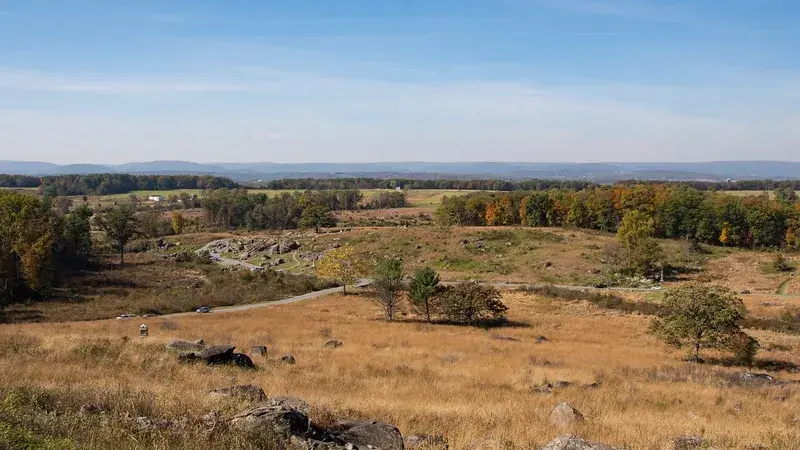
But the retreat ended at Cemetery Hill, the high ground south of town that Buford had identified as the key terrain. As darkness fell, Union forces consolidated on a fishhook-shaped defensive line running from Culp's Hill through Cemetery Hill and south along Cemetery Ridge to the rocky hills of Little Round Top and Big Round Top. Lee had won the day's fighting, but the Union held the high ground — — and in Civil War combat, elevation was everything.
Day Two —€” July 2: The Bloodiest Day
Lee's plan for July 2 called for Lieutenant General James Longstreet to attack the Union left flank while Lieutenant General Richard Ewell demonstrated against the right at Culp's Hill and Cemetery Hill. Longstreet objected strenuously —€” he wanted to maneuver around the Union left and force Meade to attack on ground favorable to the Confederacy. Lee overruled him. The attack would proceed as planned.
Longstreet's assault, delayed until late afternoon by difficult terrain and the need to march his corps into position without being observed, struck the Union line at its most vulnerable point. General Daniel Sickles had advanced his Third Corps forward from Cemetery Ridge to higher ground along the Emmitsburg Road, creating a salient that Longstreet's men hammered from two sides simultaneously.
The fighting that followed produced some of the war's most legendary engagements. The Wheatfield changed hands six times in brutal close-quarters combat. The Peach Orchard became a killing field where artillery fire shredded advancing infantry at point-blank range. At Devil's Den, sharpshooters turned the boulder-strewn hillside into a nightmare of ricocheting bullets and impossible angles.
The day's most critical moment came at Little Round Top, the rocky hill anchoring the extreme left of the Union line. Colonel Joshua Lawrence Chamberlain and the 20th Maine Infantry, running out of ammunition after repeated Confederate assaults, fixed bayonets and charged downhill into the attacking Alabamians — — a desperate gamble that secured the position and prevented the collapse of the entire Union flank. Had Little Round Top fallen, Confederate artillery placed on its summit would have commanded the entire Union line along Cemetery Ridge.
Day Three —€” July 3: Pickett's Charge
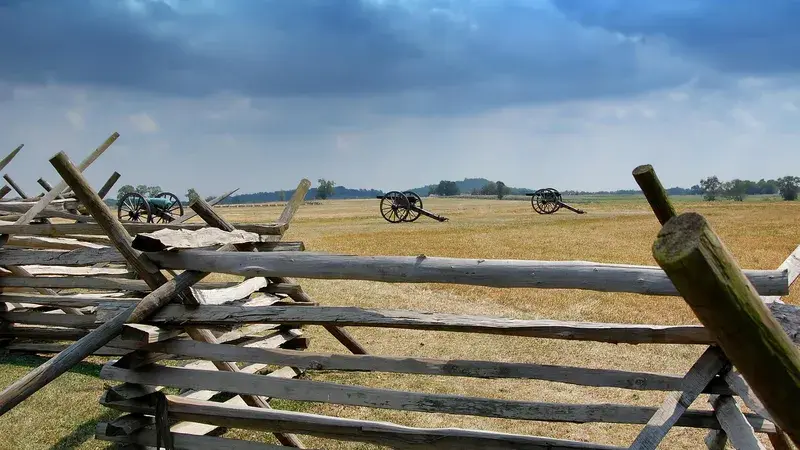
Despite two days of failed attacks and Longstreet's continued objections, Lee ordered a massive frontal assault against the center of the Union line on Cemetery Ridge. The attack, forever known as Pickett's Charge, sent approximately 12,500 Confederate soldiers across three-quarters of a mile of open ground under concentrated artillery and rifle fire.
The assault began with a two-hour artillery bombardment intended to suppress the Union guns on Cemetery Ridge. The barrage was the largest of the entire war —€” over 150 Confederate cannons firing simultaneously — but most rounds sailed over the ridge, leaving the Union infantry relatively unscathed. When the guns fell silent and the infantry stepped off, they advanced into a storm of canister shot, shell fragments, and massed rifle fire that tore gaps in their formations with mechanical efficiency.
Some Confederates reached the stone wall at the crest of the ridge — — a moment known as the "High Water Mark of the Confederacy —" — but were overwhelmed by Union reinforcements converging from both sides. The survivors streamed back across the field, leaving nearly half their number dead or wounded on the slope. Lee rode out to meet the shattered regiments, reportedly telling them, "It is all my fault."
The Aftermath and the Address
Lee's invasion of the North, undertaken in hopes of further discouraging the Union and possibly inducing European countries to recognize the Confederacy, had ended in failure. Lee retreated toward Virginia on July 4 in a wagon train of wounded that stretched seventeen miles. Meade pursued cautiously but failed to deliver a crushing blow before Lee crossed the Potomac. The strategic impact was nonetheless decisive —€” Lee would never again launch a major offensive into Union territory. Combined with the fall of Vicksburg on the same day, July 4, 1863 marked the turning point of the Civil War.
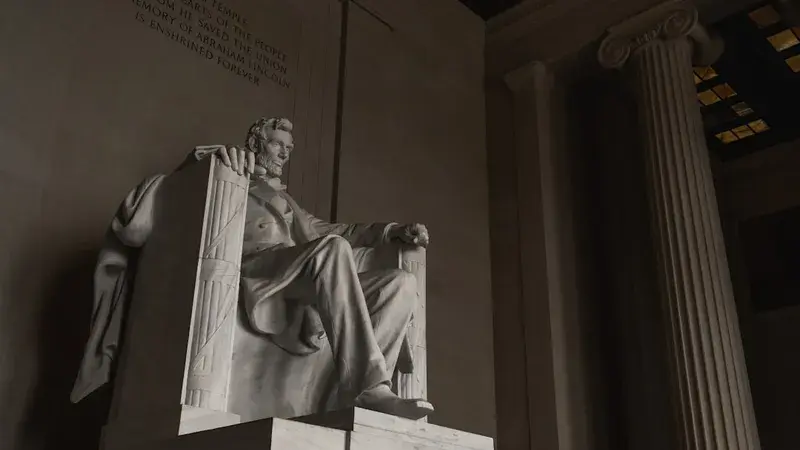
The scale of death at Gettysburg overwhelmed every existing system for dealing with casualties. Thousands of bodies lay unburied in the July heat. Local civilians, many of whom had sheltered in their basements during the battle, emerged to find their town transformed into an open-air hospital and morgue. The establishment of a national cemetery on the battlefield — — dedicated by Abraham Lincoln's famous address in November 1863 — — represented a new commitment to honoring the war dead that would reshape American memorial culture permanently.
Visiting the Battlefield Today
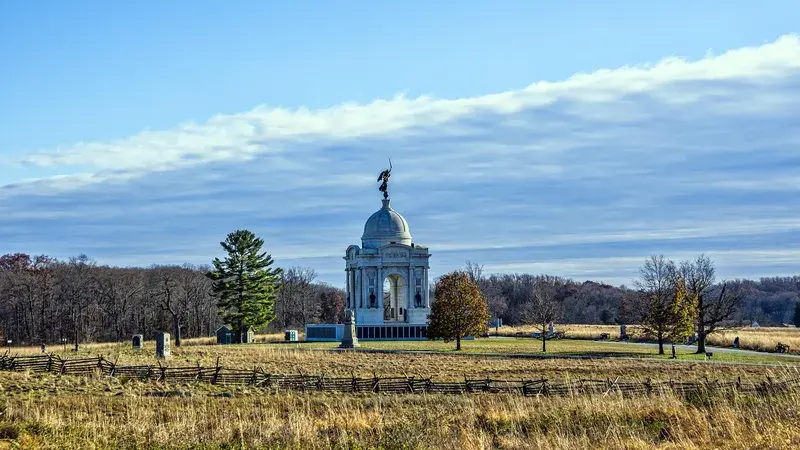
Gettysburg National Military Park preserves over 6,000 acres of the original battlefield, making it one of the most complete Civil War sites in existence. The park includes over 1,300 monuments, markers, and memorials — — more concentrated commemorative sculpture than anywhere else in the Western Hemisphere. The Museum and Visitor Center houses the restored Gettysburg Cyclorama, a massive 360-degree painting of Pickett's Charge completed in 1884.
The battlefield lends itself to both driving tours and walking exploration. Auto Tour routes cover the major landmarks with interpretive signs, while hiking trails access more remote areas including Devil's Den, the Wheatfield, and the wooded slopes of Culp's Hill. Licensed Battlefield Guides offer two-hour vehicle tours that provide context no signage can match — — many of these guides are published historians with decades of specialized knowledge.
For visitors interested in the paranormal side of Gettysburg, the battlefield and surrounding town host dozens of ghost tour operations. The concentration of violent death in such a compact area has made Gettysburg one of the most actively investigated haunted locations in the United States. Whether you come for the history, the ghosts, or both, the landscape itself delivers — — these fields still carry the weight of what happened here, and walking them changes how you understand the war.