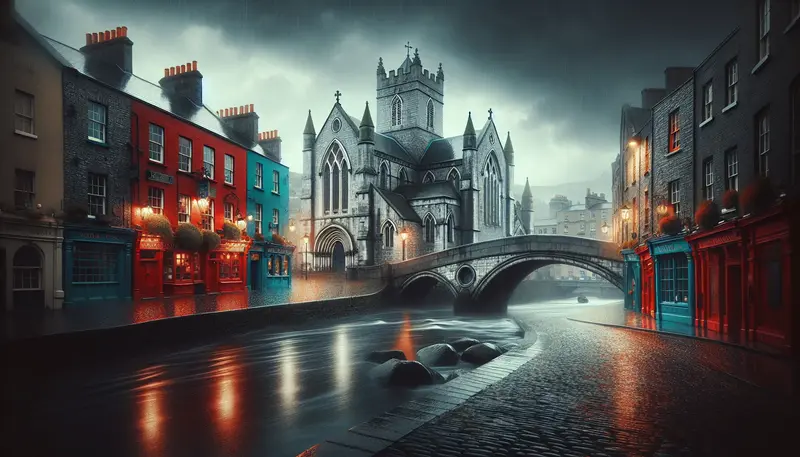
In the vaults beneath St. Michan's Church lie mummified remains dating back centuries — preserved by the limestone walls and dry atmosphere.
This article is part of our comprehensive Dublin ghost tours guide. Whether you're planning a visit or researching from afar, these stories reveal a side of Dublin most visitors never see.
What secrets do the vaults of St. Michan's hold?
What lies beneath Church Street in Dublin has attracted curiosity for centuries. St. Michan's Church, on Church Street (Dublin 7), sits above a series of stone vaults where a small group of remarkably preserved bodies has raised questions of history, mortality, and the supernatural. The church's site traces back to at least the late 11th century — the first recorded church was established around 1095 — while the fabric of the present building largely reflects later rebuilding phases, with the current structure dating in form to the late 17th century. The vaults themselves, however, contain material that appears to predate that rebuild, so the site functions as a multilayered archive of Dublin's past.
St. Michan's attracts not only those interested in ecclesiastical architecture and Dublin antiquities but also people drawn by its reputation in local ghost lore. References to a "Dublin ghost" or "Dublin haunted" setting often center on these subterranean spaces: a dim, cool network of stone passages where preserved human remains remain visible behind iron bars. While the description can sound sensational, the accounts offered by historians, conservation specialists, and long-term guides focus on verifiable facts — the architecture of the vaults, the visible embalming signs, and the environmental conditions that led to mummification — while leaving room for the anecdotal reports that populate oral tradition.
This section sets the scene for a detailed look at what is confirmed, what is inferred, and what local witnesses have reported. The aim is to present a careful balance of documented history — dates, locations, structural facts — and the folklore that has become part of the place’s identity. The vaults are a physical, archaeological phenomenon first; the stories that gather around them come second, and both deserve attention when assessing why St. Michan's still fascinates modern visitors.
The mummies: identity, preservation, and notable remains
The vaults of St. Michan's contain several mummified bodies and skeletal remains that span a range of probable dates. The preservation owes less to intentional embalming and more to a confluence of environmental factors: porous limestone, dry air, and the presence of iron-rich clay within the vaults appear to have desiccated soft tissues and inhibited decay. As a result, faces, hands, and clothing details on some individuals remain startlingly intact. Conservators and historians estimate that some remains may be several centuries old; at least one figure is commonly described in popular accounts as being possibly medieval, while others date more plausibly to the 17th or 18th centuries.
Among the most discussed are a male figure often called the "Crusader" in tourist literature, a female figure described in many accounts as a nun, and several individuals whose clothing and coffins indicate wealth or clerical status. Local guides and church records caution that the "Crusader" label is a popular nickname rather than a scholarly identification; the evidence for an exact date and occupation for any single mummy is usually circumstantial, based on coffin style, shroud fragments, and hand position. Scientific analysis — where allowed and performed — has provided clearer chronological ranges for individual remains, but comprehensive radiocarbon dating has not been widely published in the public domain. For related history, see our bram stoker's dublin: where dracula was.
These physical facts are important for understanding the interplay between the remains and the stories that follow them. The visceral sight of faces and hands in low light prompts questions: Whose lives were these? Were they nobility, clergy, or ordinary citizens? That ambiguity is part of the reason the vaults became a locus for both sober historical inquiry and local legend. For researchers, the vaults present a controlled but fragile archive; for the curious public, they present an evocative encounter with Dublin’s mortality and memory.
Documented history, architecture, and conservation efforts
St. Michan's Church is situated on Church Street, one of Dublin's oldest thoroughfares, and the building visible today reflects post-medieval reconstruction following centuries of use. The present structure, in its main form, dates from the late 17th century, though the site’s ecclesiastical function extends much earlier. The vaults lie beneath the nave and aisles and were used over successive centuries as family burial vaults for prominent local Anglo-Norman and later families. Documentary records, parish registers, and architectural surveys provide the backbone for dating and contextualizing the site.
Conservation has been a recurring concern since the 19th century, when antiquarians first drew attention to the preserved bodies. Victorian interest in curiosities led to increased public exposure of the vaults; by the 20th and 21st centuries, conservationists sought to balance public access with preservation. Modern approaches emphasize environmental monitoring, controlled access, and non-invasive study techniques. For example, humidity and temperature regulation within the vault spaces are crucial because fluctuations can accelerate deterioration of desiccated tissue and textile remains.
Archaeological and archival work has clarified aspects of provenance for some vault occupants: coffin styles, metal fittings, and surviving garments allow comparative dating. However, full anthropological analyses are limited — both by the delicate nature of the remains and by ethical constraints on invasive testing. The conservation community and the parish have collaborated on stabilizing in-situ remains, improving protective screens, and updating interpretive materials so that visitors can understand what is known, what is hypothesized, and why certain tests are not undertaken publicly. These documented efforts emphasize respect for the dead as well as for the scientific value of the site. For related history, see our the hellfire club: dublin's most sinister.
Reported paranormal experiences: testimonies and context
Accounts of strange experiences at St. Michan's have circulated in oral tradition, guide anecdotes, and visitor reports. Two commonly recurring types of reports are sensory impressions (sudden drops in temperature, perceived breath or smell where none should be) and photographic anomalies (orbs, unexplained light streaks). Because the vaults are subterranean, naturally cool, and dimly lit, sensory anomalies can often be explained by airflow patterns, microclimate changes, or optical artifacts. That said, certain first-person reports resist quick explanation, and they shape the church’s reputation as both a historical site and a locus of haunting narratives.
One frequently recounted testimony comes from a long-term church guide who reported — during a quiet winter evening tour in the early 2000s — that a guest felt a distinct, warm pressure on the back of the neck while standing before a particular coffin. The guest described a whisper-like sound and a sudden emotional wave of sadness that passed as quickly as it arrived. The guide, who requested anonymity in some press recountings, noted that the visitor’s story matched others in its specificity of place and sensation, even if the cause remained unknown. Another report involves a visitor who photographed the vault interior in daylight. On review, the image contained a luminous blur not aligned with any visible light source in the church and not consistent with the camera’s recorded exposure settings. The visitor offered the image to local researchers and social historians; while some analysts suggested lens flare or internal reflection, others left the matter unresolved.
These testimonies, common in accounts of any reputedly haunted site, sit alongside more mundane explanations that historians and scientists offer. The important point for the responsible chronicling of such reports is to record them accurately and to contextualize them against the environmental and psychological variables that can produce unusual experiences. For many researchers and visiting journalists, the combined presence of credible eye-witness recounting and environmental curiosity is enough to keep the conversation going without turning anecdote into proof.
Folklore, literary connections, and the cultural afterlife of the vaults
St. Michan's vaults have accumulated a cultural biography that reaches into Dublin folklore and literary history. Bram Stoker, the Dublin-born author of Dracula, is frequently mentioned in connection with many Dublin sites of decay and mystery; while direct documentary evidence tying him specifically to the St. Michan vaults is limited, local lore credits many local subterranean spaces as part of the imaginative terrain that fed late-Victorian Gothic interest. More reliably, the vaults feature in guidebooks, collections of Dublin legends, and local oral histories dating from the 19th and 20th centuries. For related history, see our kilmainham gaol: dublin's most haunted building.
Local legend supplies several recurring motifs: the idea that one of the mummies resembles a national figure, rumors of whispered warnings from the vaults at certain hours, and stories that the vaults once held the remains of men involved in famous historical events. These motifs are typical of how communities attach meaning to physical remains; they are often less about historical accuracy and more about memory, identity, and the layering of meaning across generations. Folklorists point out that such stories help communities process mortality and social change by locating the past in visceral, visible objects.
In contemporary terms, the vaults operate as both a tourism site and a locus of heritage memory. They headline in lists of "Dublin ghost" and "Dublin haunted" places, which in turn brings a certain expectation among visitors. Guides and parish staff manage that expectation by offering careful narration that distinguishes verifiable history from legend, saying clearly when a story is rooted in archival evidence and when it is an oral tradition. That approach has kept the site both approachable for casual curiosity and respectful as a place where deceased people remain interred.
Visiting, etiquette, and research guidance
The vaults beneath St. Michan's are accessed from the church on Church Street (Dublin 7), but public access is controlled: tours and viewings are typically offered under the supervision of church staff or authorized guides in order to protect the fragile environment. Visitors who wish to pursue research should contact the parish or the custodial authorities in advance; scholars seeking material sampling or invasive analysis will usually need formal permissions and to demonstrate a conservation plan that justifies any intervention.
Etiquette for visitors emphasizes respect. Photography may be restricted in certain areas to prevent flash damage and to protect other visitors’ experience; touching remains or removing any small fragments is strictly prohibited. Even when the impulse to capture an evocative image is strong, guides ask that guests remember these are the remains of people, not props. For those interested in the site's paranormal associations — listed in many guides under "Dublin ghost" or "Dublin haunted" keywords — the recommended approach is curiosity paired with critical inquiry: listen to witness accounts, note the environmental explanations, and be aware of how lighting, acoustics, and crowd dynamics shape perception.
For anyone seeking deeper information, archival sources include parish registers, local architectural surveys, and contemporary newspaper accounts going back to Victorian antiquarians who first popularized the vaults in print. Conservation briefs and statements prepared by heritage professionals explain what has been done to stabilize remains and why further intervention is often limited. Whether approaching St. Michan's as an object lesson in funerary archaeology, a site of local legend, or a reputedly haunted space, the most valuable stance is one of respectful attention to both historical fact and the narratives people have built around this singular Dublin place.