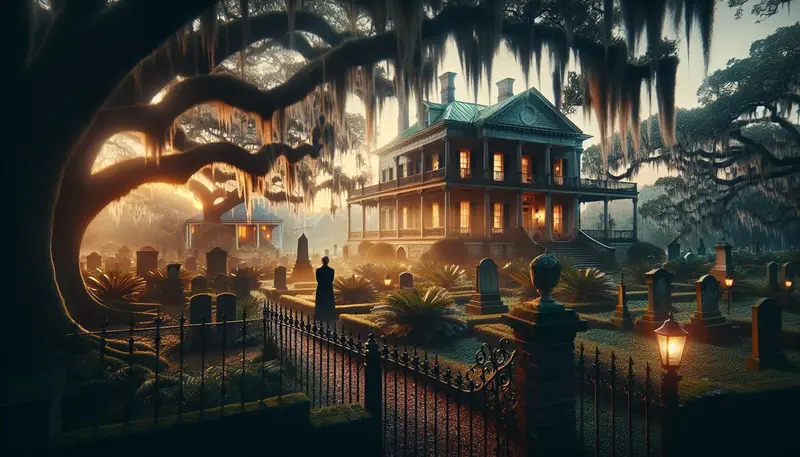
Jim Williams shot his assistant Danny Hansford in the study in 1981. Four trials later, the house's reputation was sealed — and the ghosts multiplied.
This article is part of our comprehensive Savannah ghost tours guide. Whether you're planning a visit or researching from afar, these stories reveal a side of Savannah most visitors never see.
House and History: Architecture, Location, and Early Owners
Have you noticed how a single address can carry a century of stories and still make your skin feel colder when you stand before it? The Mercer-Williams House at 429 Bull Street, Savannah, Georgia 31401, occupies the entire eastern side of Monterey Square and is one of the city’s most photographed residences. Built in the 1860s in the Italianate style, the mansion’s red-brick façade, bracketed eaves, tall windows, and lavish interior speak to Savannah’s antebellum aspirations and the later Hill-era restorations that defined the city’s preservation movement.
The house was originally built for General Hugh W. Mercer (1819–1877), a Confederate veteran and the grandson of a Revolutionary War hero. Construction began in the 1860s and finished when Savannah’s postwar architecture took shape, giving the property its stately presence. In 1969, antique dealer and preservationist James Arthur “Jim” Williams (1926–1990) purchased and restored the property, furnishing it with period antiques and artworks that attracted socialites, collectors, and visitors. It is the combination of architectural grandeur, high-society restoration, and the violent events that would occur there in 1981 that made 429 Bull Street a focal point for both historical interest and local lore.
As you approach the iron gate and walk the patterned brick path toward the front door, you’re looking at a house that functions as both museum and memorial. The Mercer-Williams House is a public-facing heritage site and private scene of tumultuous events — a dual nature that feeds the reputation of a Savannah ghost and the notion of a Savannah haunted mansion in local storytelling. Whether your focus is architecture, social history, or the uncanny, the building’s provenance anchors the legends that follow in documented fact.
The Night of May 2, 1981: Murder at 429 Bull Street
Do you picture the layout inside the mansion when you read about the shooting? On the night of May 2, 1981, at approximately 10 p.m., Danny Hansford (born 1960) was shot and killed inside the Mercer-Williams House. Hansford, a 21-year-old antiques dealer and part-time assistant to Jim Williams, died after an altercation in the first-floor parlor, with the shooting occurring in what is now the central gathering room of the museum. The event was immediately headline news in Savannah and would later become central to John Berendt’s bestselling 1994 book Midnight in the Garden of Good and Evil, which brought national attention to both the case and the house.
Local law-enforcement records and contemporaneous reporting place the shooting at the Mercer-Williams House, and the coroner’s report confirmed a single gunshot wound as the cause of death. Witness accounts from that night diverge: some described a confrontation and sudden escalation, while others offered details about loud voices, commotion in the main rooms, and a chaotic exit from the premises. This mixture of testimony is part of why the incident spawned multiple prosecutions and a long legal saga that kept the house and its owner in public view for much of the 1980s. For related history, see our bonaventure cemetery: savannah's hauntingly beautiful city.
The shooting’s physical location inside the house—the parlor and first-floor rooms near the front of the building—remains a point of pilgrimage for those interested in true crime and the paranormal. Whether you’re examining police reports, reading contemporary Savannah Press coverage, or following the footprints left in Berendt’s narrative, the night of May 2, 1981 is the pivotal historical event that continues to shape both the documented history and the folklore surrounding this Savannah haunted site.
Jim Williams, the Trials, and Public Response
Are you curious how one man’s life came to be so tightly tied to a house that the address itself became shorthand for scandal? Jim Williams (James Arthur Williams) was a wealthy antiques dealer, preservationist, and social figure in Savannah who bought the Mercer House in 1969 and spent years restoring it. After the death of Danny Hansford, Williams was charged with murder and faced a series of criminal trials that riveted Savannah and, eventually, the nation.
Between 1982 and 1989 Williams was tried four times on charges stemming from the 1981 shooting. The repeated trials, assorted appeals, and shifting jury outcomes made headlines and produced a long-running saga that affected Savannah’s civic life and the Mercer House’s public image. The trials also framed how residents and visitors talked about the house: as both artifact and crime scene. John Berendt’s narrative later amplified public fascination by placing the trials within a larger social portrait of Savannah.
For a concise view of the legal chronology, consider the following timeline (summarized from court records and local reporting):
| Date | Event |
|---|---|
| May 2, 1981 | Shooting of Danny Hansford at 429 Bull Street |
| 1982–1989 | Series of four trials, appeals, and legal maneuvers related to Williams’s prosecution |
| 1994 | Publication of John Berendt's Midnight in the Garden of Good and Evil, bringing national attention |
The exact legal outcomes and procedural details are preserved in court dockets, appeals records, and archival reporting — if you want to follow the law as it unfolded, the Chatham County court archives and contemporary Savannah Morning News articles are the primary sources to consult. That public record is the firm foundation under the house’s later reputation as a Savannah ghost hotspot. For related history, see our most haunted places in savannah: a.
Documented Ghost Reports and Witness Accounts
Have you heard people say the house “feels” different after dark? Accounts of unusual phenomena at the Mercer-Williams House have circulated since the 1980s, and many reports come from people who spent significant time in the building: docents, restoration workers, neighbors, and visitors. When you look at what’s reported — and who reported it — you can separate contemporary folklore from recurring testimony that deserves attention.
John Berendt, author of Midnight in the Garden of Good and Evil (published 1994), conducted interviews in the late 1980s and recorded anecdotes from locals who said the Mercer-Williams House carried a distinctly charged atmosphere after the 1981 shooting and throughout the trial years. Berendt’s reporting includes neighbors’ and acquaintances’ recollections of late-night disturbances, and he quotes local figures who believed the house retained an echo of the events that transpired there. One oft-cited claim in local tours is that on several occasions staff and guests reported hearing the sound of a single gunshot or abrupt thud where no explanation could be found — an auditory flashback tied to May 2, 1981.
Other specific reports have come from museum staff and guides who spend hours in the building. On more than one occasion docents have reported sudden, inexplicable cold spots in the parlor, the same room associated with the shooting, and have described the sensation of being watched while on evening tours. A number of visitors have also reported seeing a pale male figure in period clothing in the upstairs windows or walking along the southern hallway; those sightings are often described as brief and non-threatening, but they remain persistent in testimonies collected by long-time Savannah tour operators. Whether you accept these accounts as paranormal evidence or psychological residue, they are an integral part of the Mercer-Williams House’s narrative, and they help explain why the house features so prominently in Savannah ghost lore.
Physical Evidence, Preservation, and Museum Status
Do you consider how physical artifacts influence your interpretation of a place? The Mercer-Williams House is both a repository for antiques and a place where traces of the past are tangible: restored plasterwork, original furnishings, and the spatial layout where documented events occurred. After Jim Williams’s death and the legal aftermath, the house transitioned into a site that is managed with both historic preservation and public interest in mind. The Mercer-Williams House Museum (operating out of 429 Bull Street) preserves many of the items Williams collected, and the structure itself is part of Savannah’s historic district protections. For related history, see our savannah's civil war ghosts: sherman's march.
Preservation matters when you’re evaluating accounts of the supernatural. Many alleged “residues” are connected to specific objects: a bent frame, a chair in the parlor, or scuffed floorboards at the threshold. Curators and conservators who work in antique houses are careful to note that environmental factors — humidity, drafts, settling timber — can account for noises, temperature changes, and even the way a room’s acoustics carry whispers. Museum staff report routine physical occurrences (creaking floors, shifting walls) that are consistent with a 19th-century building, and they document those effects as part of conservation records.
At the same time, the house’s status as a museum means you can see where events occurred. The parlor, the adjoining rooms, and the staircases are accessible for documented tours and scholarly study, which helps you match stories to physical space. If you’re researching history or the paranormal, primary-source materials — police reports, court documents, and the museum’s own accession and restoration logs — are where you should start. Those records help you distinguish provenance and conservation facts from later legend, and they keep the house’s history anchored to verifiable detail even when you’re trying to make sense of the more uncanny reports.
How to Approach the Mercer-Williams House: Responsible Visiting and Careful Skepticism
Do you want to take a thoughtful approach when you visit a place with a complex history? If your interest in the Mercer-Williams House is driven by true crime, historic architecture, or the Savannah ghost circuit, approach the site with both curiosity and respect. The house sits within a living neighborhood and is a conserved historic property — visitors should be mindful of private-property boundaries, scheduled tours, and the interpretive aims of museum staff who steward the building’s public story. Many local tour companies and the Mercer-Williams House Museum itself are explicit about preserving dignity while recounting the events of May 2, 1981.
On the question of evidence and testimony, adopt a stance of respectful skepticism: treat reports of apparitions, voices, or cold spots as data points rather than definitive proof. When staff or long-time locals recount experiences, listen for patterns — repeated descriptions of the same room, auditory phenomena at specific hours, or similar visual sightings — and then look to corroborating documents when possible. That method is how you separate sensationalized claims from repeated testimony that merits further investigation.
Finally, if you’re part of a community that wants to write, photograph, or record at the house, do so with regard for preservation ethics and local laws. The mansion at 429 Bull Street is both a Savannah haunted landmark in popular imagination and a carefully maintained historic site. By documenting what you observe, citing dates, and comparing your account with archival sources — for example, the Savannah Morning News archives or court records related to the 1981 shooting — you contribute responsibly to the ongoing conversation about the Mercer-Williams House. Whether your interest is academic, paranormal, or personal, grounding your curiosity in verifiable facts will help you and others better understand why this house remains central to Savannah ghost lore and the city’s haunted storytelling tradition.