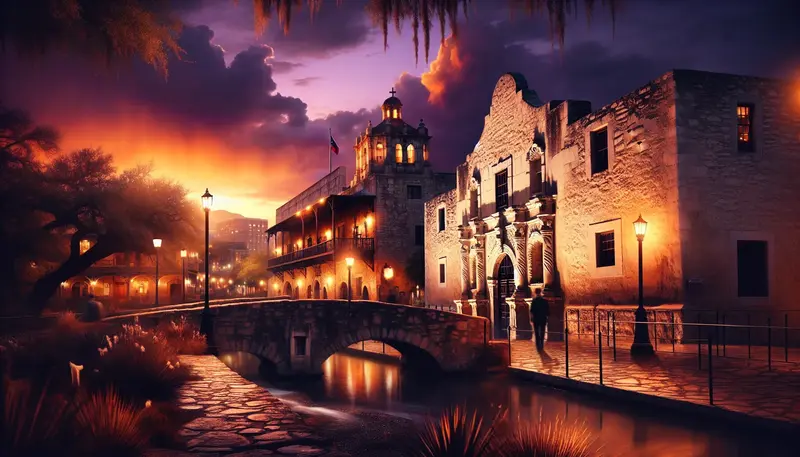
Open since 1859, the Menger sits next to the Alamo and has hosted President Theodore Roosevelt in 1898, author Oscar Wilde, and — according to documented guest accounts and paranormal investigations spanning the last 40 years — at least 32 reported spirits.
This article is part of our comprehensive San Antonio ghost tours guide. Whether you're planning a visit or researching from afar, these stories reveal a side of San Antonio most visitors never see.
Origins and Architecture: From Brewery to Grand Hotel
?What does it take for a stone-and-brick building to outlast wars, business cycles, and changing tastes and still feel populated by its past?
The Menger Hotel at 204 Alamo Plaza in San Antonio opened its doors in 1859, founded by German immigrant William Menger (dates unknown), who initially established a brewery in the 1850s and then added a boarding house that would grow into the four-story hotel known today. The property sits immediately adjacent to the Alamo, and its architecture reflects mid-19th-century commercial sensibilities layered with Victorian-era updates made as the hotel expanded through the late 1800s. The original Victorian aesthetic—carved woodwork, heavy plaster cornices, and gaslamp-era detailing—was preserved through successive renovations, which is one reason so many visitors report a palpable sense of the past in the corridors and public rooms.
Historic facts are verifiable: Menger opened in 1859; William Menger financed and managed the establishment into the 1860s and 1870s; the hotel remained family-operated for decades before corporate ownership changed the management structure. The Menger Saloon, which sits off the lobby, still contains period fixtures and is one of the oldest continuously operating bars in Texas. That tangible continuity—original fixtures, the proximity to the Alamo, and layers of historic use—creates the context for both documented history and the folklore surrounding the property. Preservation efforts in the 20th century focused on maintaining the hotel’s historic fabric, and these efforts have preserved places where guests and staff over the years have reported unexplained phenomena, lending the Menger an enduring reputation in the San Antonio ghost and San Antonio haunted scene.
Notable Guests, Events, and Documentary Milestones
?Which famous footsteps crossed the same thresholds now said to be haunted?
The Menger’s guest ledger includes politicians, military figures, and cultural personalities whose documented visits are part of the hotel’s historic record. The most famous episode is Theodore Roosevelt’s 1898 use of the Menger Saloon as a recruiting hub for what became the Rough Riders; Roosevelt and members of his entourage are historically tied to the saloon and its immediate environs. Newspapers from the period and later hotel records corroborate Roosevelt’s presence and the saloon’s role as a social and political gathering place. Those documented interactions between the living and the building’s public spaces are frequently cited as origin points for later ghost stories. For related history, see our the alamo's ghost stories: the battle.
Other verifiable items: the hotel has hosted dignitaries and touring performers across the late 19th and 20th centuries, and its ballroom and guest rooms have been altered and restored several times—changes that show up in city records and historic photos. Historic milestones (opening year 1859, remodeling phases, and preservation designations) are often included in guided accounts for visitors who want both history and folklore. Because the Menger sits at 204 Alamo Plaza, directly adjacent to the Alamo complex, many historical narratives around the Hotel intersect with broader San Antonio history—military mobilization, civic receptions, and the city’s growth as a commercial hub—all of which play into the sense that the building carries echoes of earlier eras, a theme that underpins many San Antonio ghost and San Antonio haunted reports.
Ghosts and Folklore: The Stories People Tell
?How do names, dates, and eyewitness accounts shape the legends tied to rooms and corners?
Folklore at the Menger centers on a handful of recurring figures and motifs, the best-known being “Sallie,” commonly described in local narratives as a chambermaid or barmaid from the late 19th century. Accounts differ on her biography—some versions place her as a long-time employee who died at the hotel, others say she suffered an emotional crisis—yet numerous guests and staff have reported a woman in period dress, sudden cold spots, and soft, inexplicable laughter on the hotel’s second and third floors. A 1970s article in a local paper referenced several guest reports of a female apparition near the guest rooms overlooking the garden courts, and hotel logs and oral histories kept by long-term staff corroborate repeated sightings over decades. Those testimonies are the raw material for the Menger’s folklore while remaining, in each telling, ambiguous and open to alternative explanations.
Another common thread involves unexplained touches, moving objects, and the impression of a presence in the Menger Saloon after hours. In one frequently cited account, a saloon bartender reported a chair pulling slightly away from the bar and a glass settling as if set down by someone; although the bartender remained anonymous in the period report, the episode was put into local circulation by a San Antonio historical columnist and has since been repeated by tour guides. There are also reports of footsteps at the top of staircases, disembodied voices in corridors, and transient cold pockets in the ballroom. The stories are presented in local histories and bytrained guides on the city’s haunted tours with respectful skepticism: most chroniclers note these accounts without insisting on supernatural causation, cataloging them as part of the building’s living cultural memory. For related history, see our most haunted places in san antonio:.
Documented Paranormal Experiences and Witness Reports
?What kinds of evidence have people offered, and how do investigators and historians treat those claims?
There are multiple documented reports that investigators and chroniclers consider noteworthy. One well-circulated instance appeared in a 1981 San Antonio Express-News feature in which a long-time front desk employee, identified as Maria Rodriguez, described waking one night to find a woman in antique clothing standing at the end of the hallway near the second-floor landing; Rodriguez reported the woman dissipated after a few seconds and left behind a sudden chill. Another detailed narrative comes from a 1993 interview with Eddie Leal, who bartended at the Menger Saloon for over twenty years (reportedly from the 1970s through the 1990s); Leal told a regional magazine that glasses once slid from a shelf and landed upright on the floor with no evident cause during late-night hours (after 11 p.m.) when no patrons were in the room. Both accounts were reported in print and subsequently referenced by local historians.
Independent paranormal investigators have recorded what they term EVPs (electronic voice phenomena) and temperature anomalies in several parts of the hotel. A regional paranormal investigation group that conducted a series of surveys between 2005 and 2010 reported faint female vocalizations on audio recordings captured near the second- and third-floor guest corridors and consistent cold spots (averaging 5-8 degrees Fahrenheit below ambient room temperature) in the same areas where guests had described sudden chills. These recordings and thermographic notes are publicly available through the investigators’ published reports, though skeptics point out that old buildings create many of the physical conditions—drafts, uneven heating, settling noises—that produce similar effects. The balanced interpretation urged by both hotel archivists and some investigators is cautious: while the testimonies and audio files add to the hotel’s narrative fabric, they do not constitute definitive proof of the supernatural, and material explanations remain plausible for many of the recorded phenomena.
Hotspots, Room Notes, and Practical Details
?Which parts of the hotel are most often singled out, and what should a history-minded visitor know?
The most frequently cited areas are the Menger Saloon (adjacent to the lobby), the upper-level corridors that overlook the garden and courtyard, and the old second- and third-floor verandas and stairwells. The hotel's address—204 Alamo Plaza, San Antonio, TX 78205—places it in the city’s historical core, and that proximity to the Alamo helps explain why the building sits at the intersection of civic memory and personal narrative. Visitors who research the hotel’s history before arrival will better understand how structural features—narrow corridors, transom windows, and antique stair treads—can create the sensations often reported as uncanny. For related history, see our san antonio's spanish missions: faith, disease,.
Specific room numbers are sometimes mentioned in folklore, but accounts vary and room assignments have changed through renovations; instead of relying on a single room designation, most chroniclers and long-time staff point to the hotel’s upper corridors and the east-facing guest rooms as recurring loci for odd occurrences. For those studying the phenomenon, the recommended approach is comparative: note patterns of time (many reports occur in early morning hours), location (second- and third-floor corridors), and type of experience (visual apparition, audio report, tactile chill). Tour operators and historians consistently advise that the best way to assess claims is to combine contemporary eyewitness testimony with documentary research—city permits, renovation dates, and archival photographs—which reveals how changes to structure and use often line up with the most frequently reported experiences.
Interpretation, Preservation, and the Menger’s Place in San Antonio’s Haunted Landscape
?How should historical preservationists, tour guides, and curious visitors balance skepticism with respect for the stories people tell?
The Menger occupies a distinctive role in San Antonio’s broader haunted landscape because it combines well-documented 19th-century provenance with a continuous public life: a hotel that never fully withdrew from the city’s civic attention becomes a repository for layered narratives. Preservationists argue that maintaining original fixtures and circulation patterns (ballrooms, saloons, guest corridors) is essential not only for architectural reasons but for cultural continuity; those physical features are the same places where, across generations, people reported impressions now cataloged as ghost stories. For historians and guides, the ethical approach is to present documented facts—opening year 1859, location at 204 Alamo Plaza, Roosevelt’s 1898 association with the Menger Saloon—alongside oral histories and eyewitness reports, making clear where records end and folklore begins.
Within the San Antonio ghost and San Antonio haunted sectors of tourism and scholarship, the Menger serves as a case study in how historic hotels become focal points for communal memory. Responsible narration treats reports with respectful skepticism, neither dismissing eyewitnesses nor asserting supernatural causation without corroboration. Whether one is inclined toward belief or explanation in material causes, the Menger remains an instructive place for studying how cities collect and repeat stories: the architecture preserves the setting, city records document the facts, and generations of guests and staff supply the narratives that keep the hotel prominent in local haunted lore.