
A Ghost Story Contest That Changed Literature
In the summer of 1816, five people gathered at Villa Diodati on the shores of Lake Geneva and accidentally invented modern horror fiction. Mary Godwin — not yet Mary Shelley — was eighteen years old. Her companion Percy Bysshe Shelley was twenty-three, already a published poet and a scandal. Lord Byron, born George Gordon Byron and the most famous writer in Europe, was twenty-eight and fleeing England ahead of a divorce and mounting rumors about his personal life. John Polidori, Byron's personal physician, was twenty and ambitious. Claire Clairmont, Mary's stepsister and Byron's sometime lover, completed the group.
This article is part of our Pop Culture Dark History collection.
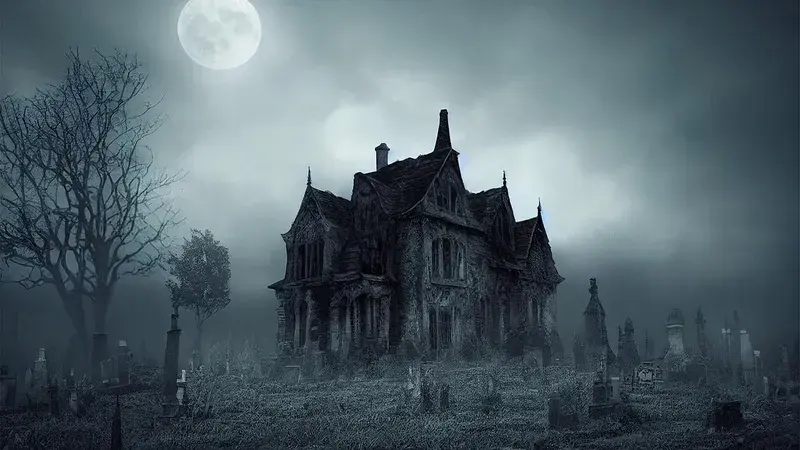
The weather that summer was catastrophic. The eruption of Mount Tambora in Indonesia the previous year had thrown so much ash into the atmosphere that 1816 became known as "The Year Without a Summer." Cold rain fell almost continuously. The group was trapped indoors at Byron's rented Villa Diodati, entertaining themselves with conversation, laudanum, and readings from a collection of German ghost stories. One evening, Byron issued a challenge: each person would write their own supernatural tale. From that contest emerged two of the most enduring figures in horror — Frankenstein's monster and the modern vampire.
Mary's Nightmare
Mary struggled with the challenge for days while the men around her produced fragments and abandoned them. Byron started a vampire tale and gave up. Shelley attempted something that went nowhere. The pressure to produce — particularly as the youngest member of a group that included two of England's most celebrated writers — was considerable. Mary later wrote that she wanted to create something that would "speak to the mysterious fears of our nature and awaken thrilling horror."
The breakthrough came in a waking nightmare. After an evening of conversation about galvanism — Luigi Galvani's experiments, conducted in Bologna, Italy, in which electrical current made dead frog legs twitch, suggesting that electricity might be the animating force of life — Mary lay in bed unable to sleep and saw, as she later described it, "the pale student of unhallowed arts kneeling beside the thing he had put together." The image of a scientist bringing a constructed being to life through forbidden knowledge arrived complete, and by morning she had begun writing what would become "Frankenstein; or, The Modern Prometheus."
The novel wasn't finished until 1817 and was published anonymously on January 1, 1818, by Lackington, Hughes, Harding, Mavor & Jones. Early reviewers assumed it was written by Percy Shelley, and when Mary's authorship was revealed in 1823, the literary establishment expressed a mixture of admiration and discomfort that a woman — and such a young one — had produced something so dark and philosophically ambitious.
What the Novel Actually Says
Popular culture has reduced Frankenstein to a simple monster story, but Mary Shelley's novel is far more complex and far more disturbing than any film adaptation has captured. The creature in the novel is not a groaning, bolt-necked brute. He is articulate, emotionally sensitive, and desperate for human connection. He teaches himself to read using Milton's "Paradise Lost," Plutarch's "Lives," and Goethe's "The Sorrows of Young Werther." He is, by any measure, a person — and the horror of the novel lies not in what he does but in what is done to him.
Victor Frankenstein creates life and immediately abandons it. The creature, born innocent, is rejected by his creator and by every human being he encounters solely because of his appearance. He asks Victor for one thing — a companion, a female creature to share his isolation — and Victor destroys her in front of him. The creature's subsequent violence is not the rage of a monster. It is the rage of someone who has been denied every form of human connection and who has concluded, through bitter experience, that the world will never accept him.
The novel asks questions that remain unanswered: What responsibility does a creator bear toward what he creates? What happens when a being capable of thought and feeling is denied a place in the world? Is the creature a monster because of what he is, or because of how he's treated? Mary Shelley, at eighteen, embedded these questions in a Gothic framework that made them emotionally devastating rather than merely philosophical. For related history, see our the amityville horror: separating truth from.
Villa Diodati and Lake Geneva
Villa Diodati still stands on the hillside above Cologny, a suburb of Geneva, overlooking Lake Geneva (also known as Lac Léman). The building is privately owned and not open to the public, but the exterior is visible from the road and from the lakeside path that runs through the area. The villa's hilltop position — with views across the lake to the Alps — makes it easy to understand why Byron chose it in May 1816 and why the group's storm-bound confinement there felt so atmospheric.
The broader Lake Geneva region is rich with literary associations beyond the Frankenstein connection. Jean-Jacques Rousseau set portions of "Julie, or the New Heloise" on the lake's shores. Voltaire lived at Ferney, just across the border in France. The region's combination of natural beauty and intellectual tradition made it a magnet for European writers and thinkers in the eighteenth and nineteenth centuries.
Geneva itself offers the Bodmer Foundation in Cologny, which houses rare manuscripts and literary artifacts, and the city's old town provides the kind of narrow streets and medieval architecture that connects visitors to the world Mary Shelley inhabited. The lake itself — massive, deep, and ringed by mountains that can appear threatening or sublime depending on the weather — remains the defining feature of the landscape and the emotional backdrop against which the novel was conceived.
Polidori's Vampire
The other enduring creation from that Geneva summer came from the least celebrated member of the group. John Polidori took Byron's abandoned vampire fragment and expanded it into "The Vampyre," published in 1819. The story's villain, Lord Ruthven, was a thinly veiled portrait of Byron himself — aristocratic, charismatic, sexually predatory, and literally parasitic — a template that would shape Dracula and all vampire fiction that followed. The story established the template for the literary vampire that would culminate in Bram Stoker's "Dracula" seventy-eight years later.
Polidori received little credit for his contribution during his lifetime. "The Vampyre" was initially published under Byron's name due to a publisher's error — or opportunism — and Byron publicly denied authorship without particularly championing Polidori's claim. Polidori died by suicide on August 24, 1821, at age twenty-five, in London, frustrated by his inability to establish a literary reputation independent of Byron's shadow despite his contributions to vampire fiction.
The Monster's Afterlife
Frankenstein's monster has appeared in over a hundred films, beginning with Edison Studios' 1910 silent short film \"Frankenstein\" directed by J. Searle Dawley, and reaching its most iconic form in director James Whale's 1931 Universal Studios adaptation starring British actor Boris Karloff as the creature. Karloff's portrayal — flat-topped skull, bolts in the neck, heavy brow, lumbering gait — has almost completely replaced Shelley's original conception in the public imagination. The novel's articulate, emotionally complex creature has been reduced to a grunting figure of menace, and the philosophical questions at the heart of the story have been largely discarded in favor of mad-scientist spectacle.
But the novel endures because those questions keep resurfacing in new contexts. Debates about artificial intelligence, genetic engineering, cloning, and technological responsibility all echo the central dilemma that an eighteen-year-old woman articulated in a rented villa during the worst summer in recorded history. Every time someone asks whether we should create something simply because we can, they're asking Mary Shelley's question. Every time a creation turns against its creator, the ghost of the creature at Lake Geneva stirs.
The storm that trapped those five people at Villa Diodati in 1816 lasted a few weeks. The stories it produced have lasted over two centuries and show no sign of fading. The monster is still out there, still asking to be understood, still waiting for an answer that never comes.