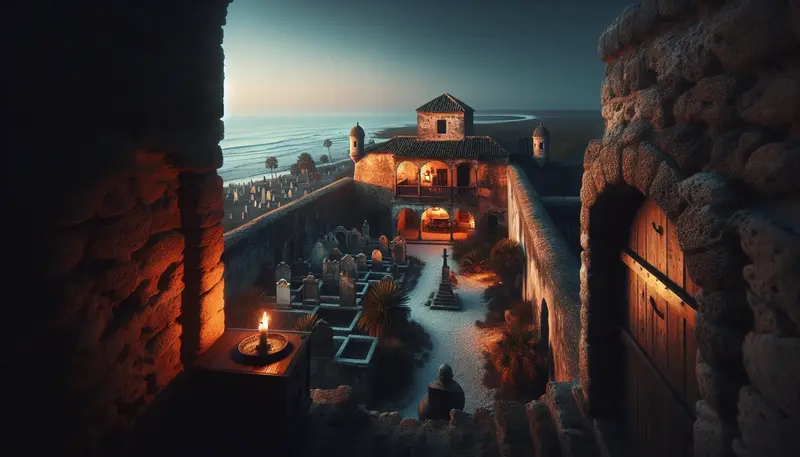
Built by the Spanish in 1672 using coquina shell, the Castillo has survived sieges, served as a prison, and accumulated centuries of ghost stories.
This article is part of our comprehensive St. Augustine ghost tours guide. Whether you're planning a visit or researching from afar, these stories reveal a side of St. Augustine most visitors never see.
What haunts Castillo de San Marcos after 350 years?
The question of why the Castillo de San Marcos in St. Augustine remains a locus for ghost stories is as old as the fort’s modern tourism. Built between 1672 and 1695, the stone fortress has stood through sieges, occupations, disease, and executions—events that supply both documented history and fertile soil for folklore. People who study haunted sites note that long-lived structures with repeated human drama, like Castillo de San Marcos, tend to accumulate stories: some are traceable to records, others grow from eyewitness accounts passed between guides and visitors.
Quick facts to anchor the stories
Grounding folklore in verifiable detail helps separate speculation from context. The Castillo occupies a waterfront site at 1 S Castillo Drive, St. Augustine, Florida 32084 (approx. 29.8956° N, 81.3124° W). Construction began in 1672 under Spanish colonial authority and finished, after interruptions, in 1695 using coquina quarried from nearby Anastasia Island. The National Park Service established Castillo de San Marcos as a national monument in 1924 and continues to manage it today. Those facts explain why the fort remains structurally intact and why it attracts both historians and accounts of the paranormal.
The phrase "St. Augustine ghost" and the related "St. Augustine haunted" tag appear repeatedly in local oral history and tourism literature; that frequency is partly why the fort’s reputation persists. Rather than treating those labels as proof, historians and park staff typically present them as social phenomena: stories that reveal how people remember and reckon with the past.
How the fort’s history created the conditions for haunting narratives
Understanding the Castillo’s documented past clarifies why haunted narratives attach to particular places inside and around the fort. Spain commissioned the fortress after the 1668–1672 period of English and pirate threats; construction began in 1672 under the governor’s authority and used labor that included enslaved Africans and Indigenous laborers. The masonry fortress completed in 1695 replaced earlier wooden palisades and became the strongest military outpost on Florida’s Atlantic coast.
Key historical dates and occupants
Major dates: 1565 (St. Augustine founded by Pedro Menéndez de Avilés); 1672–1695 (Castillo construction under Spanish Governor Manuel de Cendoya and completed by Governor Sebastián de Salas y Valdés); 1763 (transfer to British control under the Treaty of Paris); 1783 (returned to Spain); 1821 (Florida becomes U.S. territory); 1898 (Spanish–American War era use); 1924 (designation as a national monument by President Calvin Coolidge). Over those centuries, the fort served Spanish, British, Spanish-again, Confederate, and United States forces at different times. Those shifts produced repeated changes in occupancy, language, and military practice—conditions that feed both documentary records and the intangible impressions visitors describe.
Material facts also shape testimony. Coquina, a soft limestone composed of shell fragments, absorbs cannon impact rather than shattering, and the fort’s narrow sally ports, casemates, and subterranean magazines create unusual acoustic and thermal conditions. These physical traits offer natural explanations for sounds, drafts, and odd light effects that many attribute to the supernatural.
Reported hauntings and the stories people tell
Over the decades, accounts have clustered around several recurring figures and experiences: a spectral soldier, a weeping woman, anguished sounds from the dungeon, and apparitions near the north bastion. Those narratives circulate among guides, local historians, Park Service staff, and paranormal investigators, and they appear in newspapers and oral histories. While folklorists emphasize pattern over proof, the individual reports are revealing about how people interpret ambiguous experiences in a place steeped in mortality and conflict. For related history, see our most haunted places in st. augustine:.
Two specific reported experiences
1) The Soldier on the Bastion: Multiple visitors and some staff have reported seeing a uniformed figure near the north bastion—often described as appearing in Spanish 17th-century attire or as a British redcoat, depending on the witness. One consistent detail in several accounts is the figure’s hovering near the embrasures at dusk, after the last tour. Witnesses describe a strong sense of presence and the sound of footsteps on the battlements when no one else is visible. Park staff have logged such reports since at least the late 20th century as anecdotal incident notes.
2) The Dungeon Moans: The casemate and magazine levels beneath the gun deck are the source of repeated auditory phenomena. Visitors have reported muffled, low vocalizations and unexplained cold spots within the vaulted rooms where prisoners were once held. In one well-circulated account, a group of night researchers from the Jacksonville Paranormal Research Society conducting EVP (electronic voice phenomenon) sessions in 2009 recorded a low, rhythmic sound they interpreted as a cry; the recording and its transcription appear in local paranormal group archives and online forums. The National Park Service does not endorse paranormal interpretations, but it acknowledges that staff and visitors consistently report anomalous sounds in the enclosed spaces, particularly in the dungeon levels where documented prisoner populations exceeded 200 during the British occupation (1763–1783).
Other recurring motifs include a woman seen near the sally port who is described as weeping—sometimes linked to documented executions and separations—and sudden temperature drops near particular embrasures. The accounts vary in precision, but their persistence across decades, tour types, and investigator groups keeps them in the local narrative.
Exact locations of sightings and how to read them
Specific spaces inside and around the Castillo attract the most reports. Mapping those complaints against the fort’s layout shows a concentration in places with particular acoustic or atmospheric properties—entrance gateways, the north and south bastions, the ditch and moat, lower casemates, and the stairwells that connect levels. Naming precise locations helps scholars and guides separate dramatic prose from repeatable observation.
Locations, addresses, and points of interest
Main address: Castillo de San Marcos National Monument, 1 S Castillo Dr, St. Augustine, FL 32084. Frequent reporting points include:
- The North Bastion: eyewitnesses often mention apparitions or footsteps on the parapet and around embrasures overlooking the Matanzas River.
- The Gun Deck and Casemates: enclosed vaults where acoustics can amplify distant sounds and create the sensation of voices or moans.
- The Sally Port (main gate area): stories of a weeping figure or of items moved by unseen hands are common in oral accounts.
- The Moat/Ditch and Outer Walls: the enclosed geometry and wind channeling often produce whistling and pressure changes that witnesses interpret as a presence.
Those locations intersect with the broader urban fabric of St. Augustine: the fort sits at the southwestern end of St. George Street and faces Matanzas Bay, so ambient city noise and waterfront weather patterns also influence what people perceive. When a visitor reports a "St. Augustine ghost" at a specific embrasure or an encounter near the drawbridge, local guides use the exact point on the map to discuss historical context—who stood there, what battles were fought, what role the space played—and to suggest non-paranormal mechanisms for the experience.
Investigations, evidence, and reasonable skepticism
Serious discussion of Castillo hauntings balances eyewitness testimony with natural explanations and the limitations of amateur investigation. Over the last thirty years, local paranormal groups and independent investigators have conducted EMF sweeps, thermal imaging, and EVP sessions; results typically yield ambiguous data that proponents interpret as suggestive and skeptics attribute to equipment sensitivity, environmental factors, or human expectation. National Park Service policy is to treat such reports as cultural memory rather than scientific proof, while recording visitor observations that may have safety or interpretive implications. For related history, see our the spanish military hospital: surgery, death,.
Common natural explanations
Several well-documented mechanisms explain many reported phenomena: acoustic resonance in the fort’s vaulted casemates can create low-frequency sounds and echoes; shifting temperatures and humidity in thick coquina walls produce condensation and draft effects perceived as cold spots; the fort’s location on the waterfront generates wind patterns that whistle through embrasures and under stair risers; insects and small animals occasionally create noises mistaken for footsteps. In addition, human cognition plays a role—expectation, prior stories, and low-light conditions enhance pattern recognition and pareidolia, making ordinary stimuli seem meaningful.
That said, the cultural value of the stories remains significant. For historians and folklorists, alleged apparitions and visitor testimonies are data about local memory and identity. They show how St. Augustine’s long colonial past is processed in the present, and why phrases like "St. Augustine haunted" enter regional discourse. The most rigorous investigators emphasize documentation: timestamps, corroborating witnesses, control recordings, and careful notation of environmental conditions—methods that raise the evidentiary bar even if they do not resolve every account.
Castillo in Context: America's Oldest City
The Castillo is one landmark within St. Augustine's 450-year history of colonial settlement, cultural conflict, and layered memory. Understanding the fort as part of that longer narrative enriches appreciation for both its documented past and its folklore.
Responsible visitation, interpretation, and safety for those drawn to the Castillo
How people approach the Castillo’s haunted reputation matters for preservation and public safety. Guides, historians, and park staff encourage respectful inquiry: treat the site as an active historic monument, comply with National Park Service rules, and avoid trespassing after hours. The fort is an educational resource as much as a setting for stories, so balancing curiosity about the paranormal with stewardship of a 17th-century structure is essential.
Practical guidance and etiquette
Visitors seeking the historical context behind haunted claims should consult the National Park Service visitor center at the fort for verified dates, exhibits, and ranger talks. Tours and interpretive materials will provide documented accounts of battles, occupations, and recorded deaths—facts that often underwrite ghost stories. For those interested in personal experience, public programs and sanctioned night or special-event hours are safer than unsanctioned presence after hours; the latter risks legal and safety consequences.
Finally, the Castillo’s stories are meaningful even to the skeptical. Whether one interprets them as evidence of the paranormal or as a collection of layered memories, they form part of St. Augustine’s living heritage. The labels "St. Augustine ghost" and "St. Augustine haunted" will likely persist, but when treated thoughtfully they can prompt richer questions: what does this place remember, how do communities narrate hardship, and how does one responsibly conserve a site where history and folklore meet?