10 Tours · 6 Articles
Rome Ghost Tours
Rome has been continuously inhabited for nearly 3,000 years. The city's relationship with death is not metaphorical—it is architectural. The Colosseum, where an estimated 400,000 people died in staged combat over four centuries, still stands as a functioning tourist attraction. Beneath the city, miles of catacombs hold the remains of early Christians, pagans, and Jewish communities. Churches display the bones of saints in jeweled reliquaries. An entire chapel is decorated with the skeletons of 3,700 monks.
The layers of Rome extend vertically. Modern streets sit 20 to 30 feet above their ancient Roman equivalents. Buildings are constructed on top of earlier buildings, which were built on top of temples, which were built on top of Etruscan tombs. Excavations for subway construction routinely uncover burial sites, temples, and artifacts that halt progress for months or years. The dead of Rome are not hidden—they are the foundation on which the living city rests.
Ghost tours in Rome access spaces that ordinary tourism overlooks: underground chambers beneath busy piazzas, medieval torture rooms, plague hospitals, and the narrow streets of Trastevere where Caravaggio once stabbed a man to death over a tennis match. The supernatural in Rome is not a genre—it is a geological layer.
Why Rome Is Haunted
The Colosseum opened in 80 AD and operated for approximately 390 years. During that period, an estimated 400,000 humans and over one million animals were killed in the arena. Gladiatorial combat, public executions, staged naval battles, and wild animal hunts were spectator events attended by up to 50,000 Romans. The underground hypogeum beneath the arena floor contained cells, cages, and mechanical lifts that raised combatants and animals into the arena through trapdoors. These spaces survive and are accessible on night tours.
Rome endured devastating plagues throughout its history. The Antonine Plague of 165-180 AD killed an estimated 5 million people across the Roman Empire. The Plague of Justinian in 541-542 AD may have killed half of Rome's remaining population. The Black Death reached Rome in 1348, and subsequent outbreaks continued through the 17th century. Mass burial sites from these pandemics lie beneath modern neighborhoods throughout the city.
The Inquisition operated in Rome from the 13th century, with the Palazzo del Sant'Uffizio adjacent to St. Peter's Basilica serving as its headquarters. Giordano Bruno was burned alive in Campo de' Fiori in 1600 for heresy. His statue now stands at the center of the piazza, facing the Vatican. Beatrice Cenci was beheaded on the Ponte Sant'Angelo in 1599 after being convicted of her father's murder—a case that became a cause célèbre and has generated ghost sightings on the bridge for over four centuries.
Caravaggio, the painter whose dramatic use of light and shadow revolutionized Western art, killed Ranuccio Tomassoni in a street fight near the Campo Marzio in 1606. The exact location—near the modern Via della Pallacorda—is included on tours that trace Caravaggio's violent life through Rome's streets. His paintings, many of which depict death with unflinching realism, hang in churches throughout the city where they were originally commissioned.
Catacomb Tours
Rome's catacombs are underground burial networks that extend for hundreds of miles beneath the city and its surroundings. The Catacombs of San Callisto on the Via Appia Antica, the largest and most visited, contain the tombs of 16 popes and approximately 500,000 burials across 12 miles of tunnels on four levels. The earliest burials date to the 2nd century AD.
BURIED IN THE SAN CALLISTO CATACOMBS
The Catacombs of San Sebastiano, also on the Appian Way, were among the first to be called "catacombs"—the word derives from the Greek "kata kumbas," meaning "near the hollow." These passages held both Christian and pagan burials, and their walls are covered in graffiti left by ancient visitors, some dating to the 3rd century.
“The San Callisto catacombs stretch for nearly 20 kilometers beneath the Appian Way, holding half a million early Christian burials.”
The Catacombs of Priscilla beneath the Via Salaria contain some of the oldest known Christian art, including a 3rd-century fresco of the Virgin Mary. The catacombs also include a Greek Chapel with frescoes depicting biblical scenes and a dining room used for funeral meals. The atmosphere underground—cool, dark, and echoing—creates a visceral connection to early Christian communities who worshipped and buried their dead in these spaces.
Colosseum & Forum Night Tours
Night tours of the Colosseum provide access to the arena floor and the underground hypogeum after the daytime crowds have left. The hypogeum's narrow corridors, animal cages, and mechanical systems are visible in ways that daytime visits—crowded with thousands of tourists—cannot provide. The acoustics underground, where sounds carry and distort through stone passages, create an environment that needs no enhancement.
The Roman Forum, adjacent to the Colosseum, was the political, religious, and commercial center of ancient Rome. The Temple of Vesta, where the Vestal Virgins maintained the sacred flame for over a thousand years, stands in partial ruin. Vestals who broke their vow of chastity were buried alive in a sealed underground chamber with a lamp, a loaf of bread, and a jug of water—a punishment that technically avoided the prohibition against shedding a Vestal's blood.
The Palatine Hill, rising above the Forum, contains the ruins of imperial palaces where emperors lived, plotted, and were frequently murdered. Caligula was assassinated in a palace corridor in 41 AD. Domitian's palace included polished marble walls that functioned as mirrors, allowing the paranoid emperor to see anyone approaching from behind. Night tours through these ruins, lit only by the city's ambient glow, offer an experience unavailable during daylight hours.
Vatican Area & Castel Sant'Angelo
Castel Sant'Angelo, originally built as Emperor Hadrian's mausoleum in 139 AD, served over the centuries as a fortress, papal residence, prison, and execution site. A secret passageway—the Passetto di Borgo—connects it directly to the Vatican, allowing popes to escape during sieges. The castle's prison cells held Benvenuto Cellini and Giordano Bruno, among others. The ramparts where Beatrice Cenci was beheaded in 1599 offer panoramic views of the Vatican and the Tiber.
St. Peter's Basilica sits above a necropolis—a Roman city of the dead—that was in use when the original basilica was constructed in the 4th century. The Vatican Necropolis, accessible by special reservation, contains pagan and early Christian tombs beneath the basilica floor. The traditional site of St. Peter's tomb, directly beneath the high altar, was excavated in the 1940s and yielded bones that Pope Paul VI declared to be Peter's in 1968.
The Ponte Sant'Angelo, the bridge leading to Castel Sant'Angelo, was built by Hadrian in 134 AD. It was used for public executions and the display of executed criminals' bodies. Bernini's angel statues, added in the 17th century, line both sides of the bridge. Ghost tours that cross the bridge at night use it as a stage for stories about Beatrice Cenci, whose apparition is said to appear on the anniversary of her death carrying her severed head.
Trastevere & Medieval Rome
Trastevere—literally "across the Tiber"—has been a distinct neighborhood since ancient times, originally home to immigrants, sailors, and working-class Romans. Its narrow medieval streets, largely unchanged since the 14th century, create an atmosphere more intimate and claustrophobic than the grand avenues of central Rome. Ghost tours through Trastevere navigate alleyways where torchlight barely reaches the upper floors.
The Basilica of Santa Maria in Trastevere, one of the oldest churches in Rome, was founded in the 3rd century on a site where oil reportedly sprang from the ground on the night of Christ's birth. The church's mosaics, dating to the 12th and 13th centuries, depict scenes of life and death in medieval Rome with a directness that later Renaissance art would avoid.
Evening tours through Trastevere combine the neighborhood's historical atmosphere with stops at trattorias and wine bars, creating an experience that blends gastronomy with ghost stories. The neighborhood's resistance to modernization—its streets too narrow for most vehicles, its buildings too old for easy renovation—preserves an environment where the medieval city is still physically present.
Bone Churches & Crypts
The Capuchin Crypt beneath Santa Maria della Concezione dei Cappuccini on Via Veneto contains the artistically arranged skeletal remains of approximately 3,700 Capuchin friars. Across six small chapels, bones form chandeliers, wall decorations, arches, and even a clock. Entire skeletons in Capuchin robes stand in niches. The display was created between 1631 and 1870 as the order's cemetery was moved underground to accommodate urban development.
CAPUCHIN SKELETONS DECORATING THE BONE CHAPEL
The Crypt of the Capuchins is not a Halloween attraction—it is a functioning religious site intended to prompt meditation on mortality. The final plaque in the crypt reads: "What you are now, we once were; what we are now, you shall be." The Capuchin museum above the crypt provides context for the order's history and their distinctive relationship with death.
Santa Maria della Concezione is open during standard church hours and requires a small donation for entry. It is included on many ghost tour routes as a stopping point, though the crypt itself is best visited during daylight when the bone arrangements are fully visible. Photography is prohibited inside the crypt.
<!-- Mobile Tour Cards (hidden on desktop where sidebar shows) -->
<TourGrid tours={tours} />
Related Reading
Explore Rome Articles
In-depth guides to Rome's haunted history, famous ghosts, and dark legends.
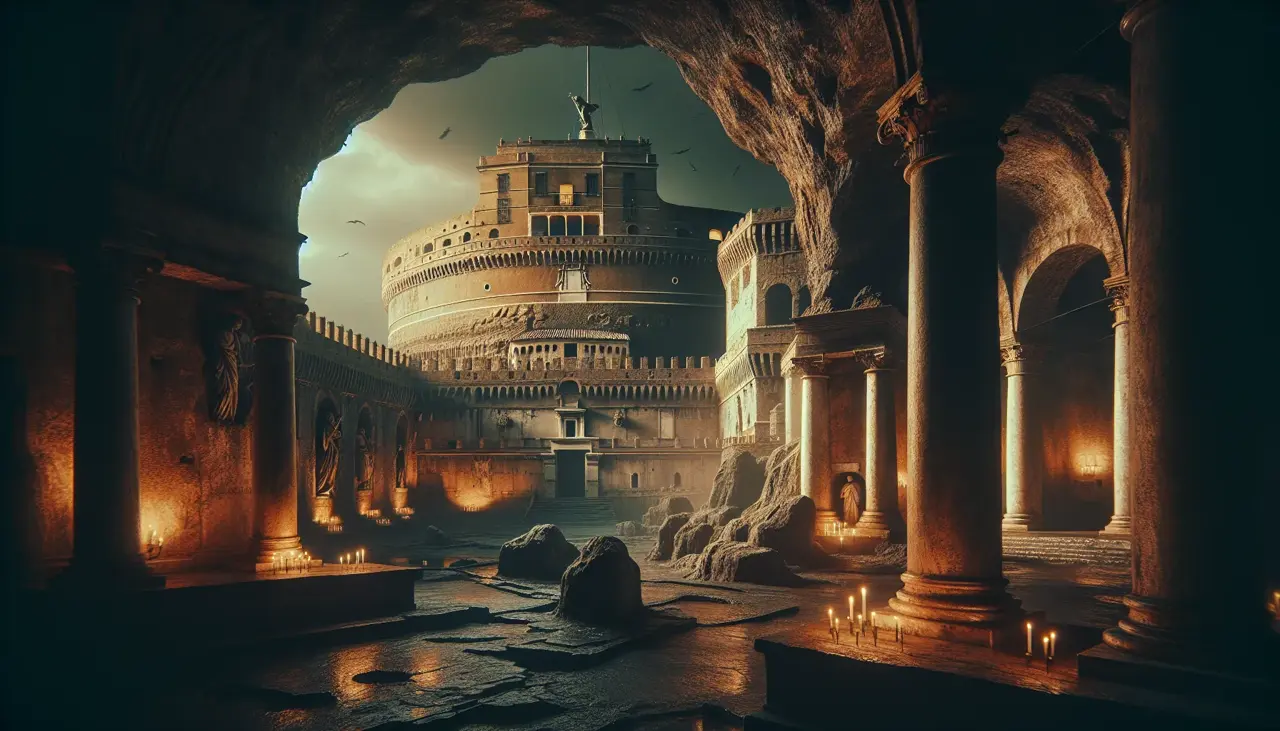
Castel Sant'Angelo: Rome's Fortress of Ghosts
Discover Castel Sant'Angelo: Hadrian's mausoleum turned papal fortress—its architecture, Passetto di Borgo, hauntings, eyewitness accounts, visitor.
Most Haunted Places in Rome: Ghosts of the Eternal City
Explore Rome's most haunted sites: Castel Sant'Angelo, the Colosseum, Piazza Navona, and the Appian Way. History, mystery, and ghostly tales.
The Roman Catacombs: Miles of the Dead Beneath the Eternal
Explore the Eternal City's catacombs: miles of burial galleries, early Christian art, archaeology, legends, and practical visiting tips.
The Colosseum's Ghosts: Gladiators, Martyrs, and 500 Years
Explore the Colosseum's haunted legacy-gladiators, alleged martyrs, hypogeum testimonies and five centuries of public death, memory, and folklore.
Nero's Ghost: How Rome's Most Infamous Emperor Still Haunts
Explore Nero's legacy in Rome—history, ruins, and folklore from the Great Fire to the Domus Aurea and Palatine, where legend and archaeology meet.
Common Questions
Frequently Asked Questions
Can you visit the Roman catacombs at night?
What is the Capuchin Crypt?
Is the Colosseum haunted?
Are Rome ghost tours available in English?
Keep Exploring
Explore More Haunted Cities
Discover ghost tours in other historic cities.