
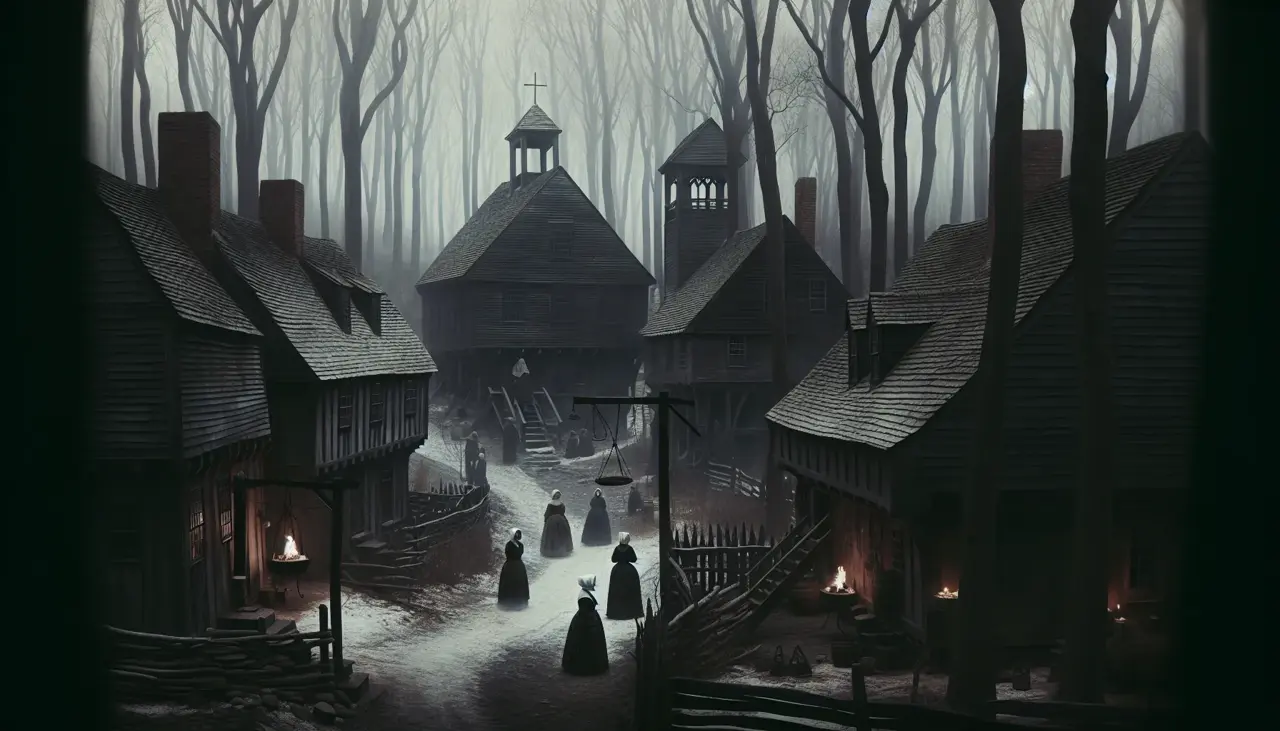
Of the more than two hundred people accused of witchcraft during the Salem witch trials, approximately three-quarters were women. This striking disproportion was not accidental. It reflected deep-seated beliefs about gender, spirituality, and social order that made women—particularly certain kinds of women—vulnerable to accusation in ways that men were not.
Understanding why women were targeted requires examining the intersection of Puritan theology, social structure, and the specific circumstances of late seventeenth-century New England.
Theological Foundations of Female Vulnerability
As documented by the National Park Service, puritan theology, as articulated by ministers like Cotton Mather (whose 1689 treatise Memorable Providences, Relating to Witchcrafts and Possessions—based on the 1688 affliction of the Goodwin children in Boston, which led to the execution of washerwoman Goody Glover—catalogued signs of witchcraft and was widely read throughout New England, including by Salem Village minister Samuel Parris) and Increase Mather, held that women were spiritually weaker than men and more susceptible to temptation—an assumption codified two centuries earlier in Heinrich Kramer’s Malleus Maleficarum (1487)—co-attributed to Jacob Sprenger, though modern scholars debate his involvement—the most influential witch-hunting manual in European history, endorsed by Pope Innocent VIII’s 1484 papal bull Summis desiderantes affectibus and reprinted in at least twenty-eight editions by 1600. This belief traced back to Eve’s role in the Fall—women had been the first to succumb to Satan’s persuasion, and that original vulnerability was understood to persist across generations.
This theological framework did not mean Puritans believed all women were evil or that godly women could not achieve salvation. But it did mean that when communities sought explanations for spiritual attack, women were natural suspects. If the Devil was recruiting servants, women—by theological definition—were more likely to be seduced. Whether religion or power drove the trials becomes clearer when examining these theological foundations.
The association between women and spiritual vulnerability was reinforced by broader cultural beliefs about female nature. Women were considered more emotional, more passionate, more governed by bodily impulses than rational men. These qualities, while not inherently sinful, were understood to create openings for satanic influence.
Gender Expectations and Deviation
Puritan society maintained strict expectations for female behavior. Women were supposed to be submissive to male authority—first fathers, then husbands. They were expected to be modest, quiet, industrious, and pious. They were to support their households without seeking public attention or exercising independent authority. Understanding life in Puritan New England reveals how strictly these norms were enforced.
Women who violated these expectations attracted attention and suspicion. Bridget Bishop (c. 1632–1692), the first person executed on June 10, 1692, at approximately sixty years of age, was known for wearing a red paragon bodice, running a tavern, and having been charged but cleared of witchcraft in 1680 — a trifecta of gender-norm violations that made her an inevitable early target. A woman who spoke too boldly, who quarreled with neighbors, who failed to show proper deference, who asserted independence beyond her station—such a woman was already marked as problematic before any accusation of witchcraft arose. This intersection of gender norms and vulnerability is crucial to understanding the broader causes and consequences of the Salem witch trials.
The accused women of Salem often fit this pattern. Tituba, the enslaved woman from Barbados who was among the first three accused, was doubly vulnerable — marked by both gender and racial otherness in a community that feared any deviation from its norms. They were women who had in some way stepped outside expected roles: widows who controlled property, women who had challenged male authority, women known for sharp tongues or contentious dispositions. Their deviation from gender norms made witchcraft accusations seem plausible to their neighbors.
Economic Vulnerability
Women’s economic position in colonial New England created specific vulnerabilities. Property typically passed through male lines, and women’s legal status was subordinate to fathers and husbands. Women who lacked male protectors—widows, unmarried women, women whose husbands were absent or incapacitated—occupied precarious positions.
This economic vulnerability took several forms. Women without male support might depend on charity from neighbors, creating resentment when assistance was sought. Widows who controlled property might be resented by male relatives who expected inheritance. Women engaged in informal economic activities—selling goods, providing services—might compete with male interests.
The accused included disproportionate numbers of women whose economic circumstances were anomalous or threatening. Sarah Good’s poverty made her dependent on neighbors’ goodwill; she was pregnant when jailed, and her infant daughter Mercy was born in custody and died there before Good’s execution on July 19, 1692. At the gallows, Good reportedly told Reverend Nicholas Noyes, “I am no more a witch than you are a wizard, and if you take away my life, God will give you blood to drink.” Good’s older daughter Dorothy (known historically as Dorcas), just four or five years old, was also accused and imprisoned for nearly eight months, emerging so traumatized that her father William later petitioned the court for damages, claiming she had been permanently broken by her ordeal. Sarah Osborne (born Sarah Warren in Watertown), who had scandalized the community by marrying her indentured servant Alexander Osborne in 1677 after her first husband Robert Prince’s death, had stopped attending church, and attempted to redirect the Prince estate away from her sons—violations of property law, sexual propriety, and religious duty that made her an early target. She died in Boston prison on May 10, 1692, without ever reaching trial. Who was actually accused reveals these economic patterns clearly.
Women as Healers and Midwives
Women in colonial New England often served as informal healers, providing medical care and midwifery services to their communities. These roles brought them into intimate contact with bodies, illness, birth, and death—domains that could easily be reinterpreted through supernatural lenses.
When patients died, when births went wrong, when treatments failed, the women who had provided care might be blamed. The same knowledge that made them valuable as healers could be reinterpreted as dangerous knowledge of poisons and curses. The line between beneficial healing and maleficent witchcraft was dangerously thin.
Several of the accused had reputations as healers or midwives. The Malleus Maleficarum had specifically identified midwives as the most dangerous class of witch, and English Puritan William Perkins’s influential A Discourse of the Damned Art of Witchcraft (1608) reinforced the suspicion that healing knowledge could mask diabolical power. Dr. Roger Toothaker, a folk healer who claimed he could identify witches, died in Boston jail on June 16, 1692; his wife Mary was also accused. Their specialized knowledge, which had served their communities, became evidence against them when the framework of interpretation shifted from natural to supernatural.
Sexual Suspicion and Moral Purity
Puritan culture placed enormous emphasis on female sexual purity. Women who had violated sexual norms—through fornication, adultery, or even suspicion of impropriety—carried moral stains that made them vulnerable to other accusations.
Several of the accused had histories that included sexual irregularity. Some had borne children outside marriage. Others had remarried too quickly after widowhood or had lived with men before formal marriage. These violations of sexual expectations provided additional fuel for accusation.
The association between witchcraft and sexuality was deeply embedded in European witch-hunting traditions. Witches were believed to have sexual relations with the Devil, to participate in obscene sabbaths, to corrupt the sexuality of others. Accusations of witchcraft carried implicit sexual charges that reinforced and amplified existing moral suspicions.
Women’s Caregiving and Vulnerability
Women’s roles as caregivers created particular vulnerability. They prepared food, tended the sick, cared for children, and managed household animals. These responsibilities placed them in proximity to domains where misfortune could occur—and where blame could be assigned.
If a child fell ill after eating food a woman had prepared, she might be suspected. If livestock died under her care, she might be blamed. If a patient worsened after receiving her treatment, she might be accused. The very intimacy of women’s caregiving work meant that they were present when things went wrong—and available as explanations.
This vulnerability was enhanced by the prevalence of conflict in daily life. Neighbors quarreled over small matters; harsh words were exchanged; grudges accumulated. Ann Putnam Jr., one of the most prolific accusers at age twelve, named over sixty people — the vast majority of them women whose families had land disputes with the Putnams. A woman who had argued with a neighbor might find herself blamed for any subsequent misfortune that befell that neighbor’s household. The accusers often drew on precisely these accumulated grievances.
Older Women and Changing Status
Older women were disproportionately represented among the accused. Women past childbearing years, women who had outlived husbands, women whose social utility in a patriarchal system had diminished—these women occupied increasingly marginal positions.
Menopause itself was viewed with suspicion in early modern culture. The cessation of menstruation was associated with the buildup of corrupt humors, emotional instability, and moral deterioration. Older women were believed to become more irritable, more envious, more dangerous as they aged.
The accused often fit this profile: women whose age had reduced their social standing, whose economic value had diminished, whose presence had become burdensome to communities or families. Their marginality made them available for sacrifice when communities sought explanations for misfortune.
The Men Who Were Accused
Not all those accused were women. Approximately one-quarter of the accused were men, and understanding why they were targeted illuminates the gendered logic of the trials by showing its exceptions.
Men accused of witchcraft often shared characteristics that feminized them in the community’s eyes: economic dependence, failed masculinity, association with accused women. Others were targeted because they defended accused wives or daughters. Still others had achieved notoriety through behavior that violated expectations in ways that paralleled female deviation.
The presence of male defendants did not undermine the gendered pattern—it confirmed it. Men were accused when they occupied positions analogous to vulnerable women, or when they allied themselves with accused women. Gender remained the primary organizing principle of vulnerability. Even Reverend Samuel Parris, whose daughter Betty and niece Abigail Williams were among the original accusers, directed suspicion overwhelmingly toward women. Judge Samuel Sewall, who later publicly repented his role in the trials, acknowledged in his January 14, 1697, public apology at Boston’s Old South Meeting House that the court had been swayed by assumptions about female weakness that he came to recognize as unjust.
Structural Patterns, Individual Victims
The gendered pattern of accusation was not random, but neither was it mechanical. Individual women were accused for individual reasons—specific conflicts, particular reputations, concrete incidents. But these individual cases accumulated into a pattern that reflected structural features of Puritan society. How the courts operated amplified rather than corrected these biases.
Women were vulnerable not because of any essential female characteristic, but because of how gender was organized in their society. The theological beliefs, economic arrangements, social expectations, and legal structures of Puritan New England combined to make certain kinds of women available as targets when communities sought to explain misfortune through witchcraft.
The Lesson of Gendered Accusation
The targeting of women in Salem carries lessons beyond its historical moment. It demonstrates how structural inequalities create vulnerability, how deviation from expected norms attracts punishment, and how systems of belief can provide justification for discrimination that might otherwise be recognized as unjust. What Salem teaches us about moral panic illuminates these recurring patterns.
The women of Salem were not accused because they were witches. They were accused because they were women—women of particular kinds, in particular positions, within a particular social structure. Their tragedy reveals how societies can mobilize against the vulnerable when fear demands explanation and existing inequalities provide targets.
Understanding why women were targeted is essential to understanding Salem. It is also essential to recognizing similar dynamics wherever they appear. Why Salem still matters today lies precisely in this enduring relevance.
For more on this topic, see our complete guide to the Salem witch trials.