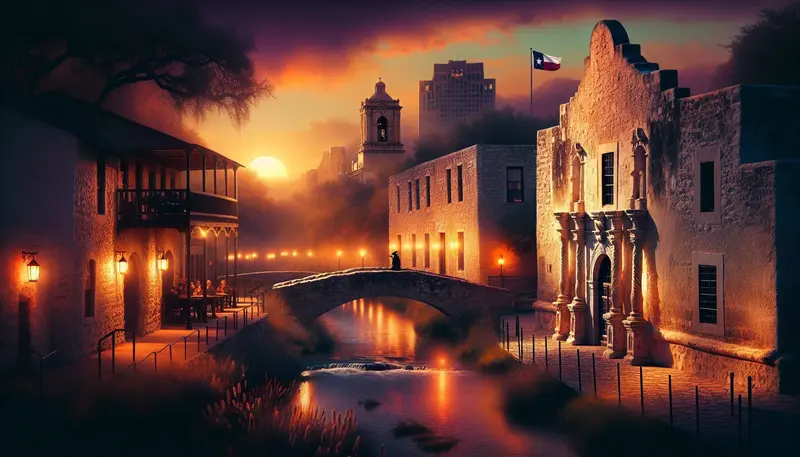
The five missions of San Antonio converted thousands — and buried thousands more. Their grounds carry 300 years of restless dead.
This article is part of our comprehensive San Antonio ghost tours guide. Whether you're planning a visit or researching from afar, these stories reveal a side of San Antonio most visitors never see.
Faith and Foundation: Why the Missions Were Built
What drew Franciscan friars, Spanish soldiers, and indigenous converts to the banks of the San Antonio River in the early 18th century?
The Spanish missions in the San Antonio region were established to secure Spain’s northern frontier, convert local indigenous people to Christianity, and create settled agricultural communities that could support presidios (military forts). The first permanent European settlement in the area, Mission San Antonio de Valero (later called the Alamo), and Mission San Francisco de la Espada, Mission Concepción, Mission San José y San Miguel de Aguayo, and Mission San Juan Capistrano formed a chain of religious, economic, and cultural institutions along the river. The initial European presence began in 1718 when Martín de Alarcón founded the civilian settlement and the mission at the river’s bend; Mission San José was formally founded in 1720 by Father Antonio Margil de Jesús and became known as the “Queen of the Missions” for its scale and architectural ambition.
These missions combined religious instruction, labor, and communal life. Franciscan friars administered sacraments and catechesis while Indigenous peoples—primarily Coahuiltecan bands and other groups—were drawn into the mission economy to farm, craft, and herd. The missions’ stone churches, acequia (irrigation) systems, and granaries shaped the landscape in ways that persist: today the San Antonio Missions National Historical Park preserves four missions and the surrounding cultural landscape, and UNESCO inscribed the missions as a World Heritage site in 2015 for their testimony to Spanish colonial missions in North America.
Understanding the missions’ founding is essential to grasp how faith, forced settlement, and cross-cultural contact created both community and vulnerability—conditions that, centuries later, feed historical interpretation and local folklore about San Antonio ghost and San Antonio haunted sites.
Disease, Demography, and the Human Cost
How did old world diseases change the lives of mission inhabitants and alter the physical record that archaeologists and historians examine today?
The arrival of Europeans brought pathogens—smallpox, measles, influenza, and dysentery—to immunologically naive indigenous populations. Epidemics struck repeatedly through the 18th and 19th centuries, reducing indigenous populations, undermining mission labor forces, and accelerating cultural disruption. Records from mission registers (baptisms, marriages, burials) illustrate mortality spikes in particular years; for example, smallpox and measles outbreaks across Spanish Texas in the mid-18th century and again in the 19th century are documented in missionary correspondence and colonial reports.
Within the missions, disease dynamics were shaped by close living quarters in the convento and by nutritional stress. Mission records and later archaeological analysis show high rates of infant and child interments in mission cemeteries, with osteological markers consistent with infectious disease and malnutrition. Colonial medical care relied on folk remedies, herbal treatments, and the occasional use of European bleeding or purgatives, practices often inadequate against highly contagious viral diseases.
These grim realities produced concentrated death in distinct places—the convento, mission cemeteries, and infirmaries—which later audiences and local storytellers link with haunted reputation. When visitors today report cold spots near an old burial area or a sense of presence in a quiet sacristy, those sensations are often connected to the documented fact that the missions were not only centers of faith and labor but also places where many suffered and died. For related history, see our the alamo's ghost stories: the battle.
Mission San José: Documented History and Reported Phenomena
What is known about Mission San José’s documented past, and how have visitors and staff described unusual experiences there?
Mission San José y San Miguel de Aguayo (6701 San Jose Dr., San Antonio, TX 78214) was established in 1720 and enlarged under Governor Martín de Alarcón and later patronage—the mission’s church and granary remain among the most complete of the mission structures. Historically it served as a major religious and agricultural center and included living quarters for families, workshops, and a formal cemetery behind the convento. The mission’s convento and its associated living spaces are the settings for many of the mission’s contemporary ghost reports.
Specific reported experiences have circulated among staff, volunteers, and visiting researchers. One consistent account involves auditory phenomena: volunteers have reported hearing the sound of infant crying coming from an empty dormitory room near the rear cemetery area. A long-time Mission San José volunteer, who provided their name to local reporters as Maria Lopez, described a late-afternoon instance in which the crying ceased the moment she opened the doorway toward the convento, but no human presence was found. Another recurring report is tactile: visitors and seasonal docents have felt sharp cold spots and the sensation of being watched in the former sacristy and the south transept, despite no obvious drafts. In 2016 a visiting student group reported their EMF detectors fluctuating near an old burial area; one student later described seeing a fleeting dark shape move past a shuttered window.
Park records show that many of the mission’s most poignant human traces—the burial ground and infirmary site—are indeed located close to the areas where people report phenomena. Those overlaps of documented death and lived memory make Mission San José an understandable focal point for both historical reflection and ghost stories that contribute to San Antonio haunted lore.
Mission Concepción and Mission Espada: Folklore, Sightings, and Named Accounts
Which mission buildings beyond San José attract reports of apparitions, and who has reported them?
Mission Nuestra Señora de la Purísima Concepción de Acuña (commonly called Mission Concepción) is one of the best-preserved mission churches in North America and sits at 807 Mission Rd., San Antonio, TX 78210, while Mission San Francisco de la Espada occupies a downstream position along the river corridor. Both sites retain intact architecture, exposed stonework, and surrounding grounds where burials and agricultural structures once stood—features that make them prominent in local ghost narratives. For related history, see our the menger hotel: san antonio's grand.
At Mission Concepción, several witnesses have described a recurring visual sighting of a man in a brown habit moving between the nave and the side chapels in the late evening hours after closing. One of the most frequently cited accounts comes from a former National Park Service ranger, Thomas Martinez, who worked at Concepción in the 2000s; Martinez reported observing a solitary figure in brown (consistent with Franciscan attire) in the nave doorway while performing a routine building check, but when he approached there was no one there and security cameras recorded no entrant. Local parishioners have also reported hearing faint, organ-like music and muted chanting during pre-dawn hours, often near the bell tower where the mission’s old bell is displayed.
Mission Espada’s reports tend toward motion and sensation. Neighbors and late-shift groundskeepers have described seeing a lone rider or the impression of a horse’s hooves crossing the acequia fields on moonlit nights—an image tied in oral tradition to the mission’s early ranching economy. In one documented case, a maintenance worker named Carlos Rivera reported, in 2014, that he smelled strong pipe tobacco in an empty courtyard and then witnessed a wooden bench swing slightly though no breeze was recorded.
These accounts—visual apparitions, residual sounds, and olfactory experiences—are often told alongside the missions’ concrete histories: friars in brown habits, frequent use of bell ringing to mark time, and the centrality of horses to mission life. Whether regarded as psychogenic response, environmental trickery, or genuinely anomalous, the stories contribute to the reputation of the San Antonio missions as San Antonio ghost and San Antonio haunted spaces.
Archaeology, Records, and How Evidence Shapes Haunting Narratives
How do archaeologists, historians, and preservationists reconcile physical evidence with stories that the missions are haunted?
Archaeology at the missions has uncovered cemeteries, foundations of infirmaries, and domestic debris—material traces that corroborate written mission registers and provide context for oral tradition. Osteological analysis often reveals high infant mortality, enamel hypoplasia (nutritional stress), healed fractures, and periosteal reactions indicative of infection. These data confirm that the missions were settings of intense suffering for many, especially children and the elderly. Such findings create a tangible substrate for later storytelling: when a visitor senses sorrowful presence near a burial area, that sense has a clear historical correlate. For related history, see our most haunted places in san antonio:.
Scholars emphasize careful interpretation. A 20th- and 21st-century conservation ethic has focused on stabilization, public access, and interpretation panels that explain not only architecture and irrigation systems but also the human costs of colonial encounters. National Park Service interpretive programs at the San Antonio Missions National Historical Park aim to present mission life holistically—faith practices, labor regimes, and the epidemiological impact of colonization—rather than romanticize or merely sensationalize tragedies. Still, because many mission buildings retain original acoustics, thick stone walls that hold temperature differentials, and complex shadow patterns at sunset, natural environmental conditions often produce phenomena—cold spots, echoes, stray sounds—that guests may interpret as paranormal.
Responsible scholarship separates verifiable facts from anecdote while preserving the latter as part of cultural memory. Oral histories and eyewitness accounts—whether reported by park staff, volunteers, or neighbors—are valuable ethnographic data that document contemporary belief and experience. For those who catalog San Antonio haunted locations, the archaeological record provides both a factual foundation and an explanation for why certain spots accumulate narrative power.
Visiting, Research, and Responsible Engagement with Haunted Grounds
What should visitors and researchers keep in mind when approaching the missions’ history and associated ghost lore?
Respect, documentation, and caution are the pillars of responsible engagement. The San Antonio Missions National Historical Park (established 1978) manages access to most mission interiors and grounds; exact policies vary by site, but after-hours entry, unaccompanied access to restricted areas, and disturbance of graves or archaeological features are prohibited. The public address for visitor information is often listed with each mission’s official signage and on the National Park Service website; Mission San José (6701 San Jose Dr.) functions as a principal visitor area and has regular hours and ranger programs. Visitors inclined to research local folklore should consult mission registers, the archives of the Archdiocese of San Antonio for sacramental records, and oral histories carried by local families and Indigenous descendants—these sources ground haunting narratives in human stories rather than one-off sensations.
When evaluating reported phenomena, a simple checklist helps separate plausible natural causes from more ambiguous claims: check for drafts, temperature gradients, localized acoustics, and modern electrical interference when devices are involved. If field researchers document an experience, they should record date, exact location (building and room or coordinates), environmental conditions, number of witnesses, and any available photographic or audio evidence. Two repeatedly reported experiences at the missions illustrate the value of documentation: the infant-crying reports near Mission San José’s convento and the brown-habit sighting at Mission Concepción have persisted because multiple witnesses, separated by time, reported similar details in recognizable locations.
Finally, treating these places with historical empathy is crucial. The combination of faith, disease, and the lived experience of mission communities makes the San Antonio missions powerful sites of memory. Whether one comes seeking architectural history, a deeper understanding of colonial encounters, or stories labeled under San Antonio ghost or San Antonio haunted, the missions demand a measured approach that honors both evidence and the intangible ways communities remember their past.